
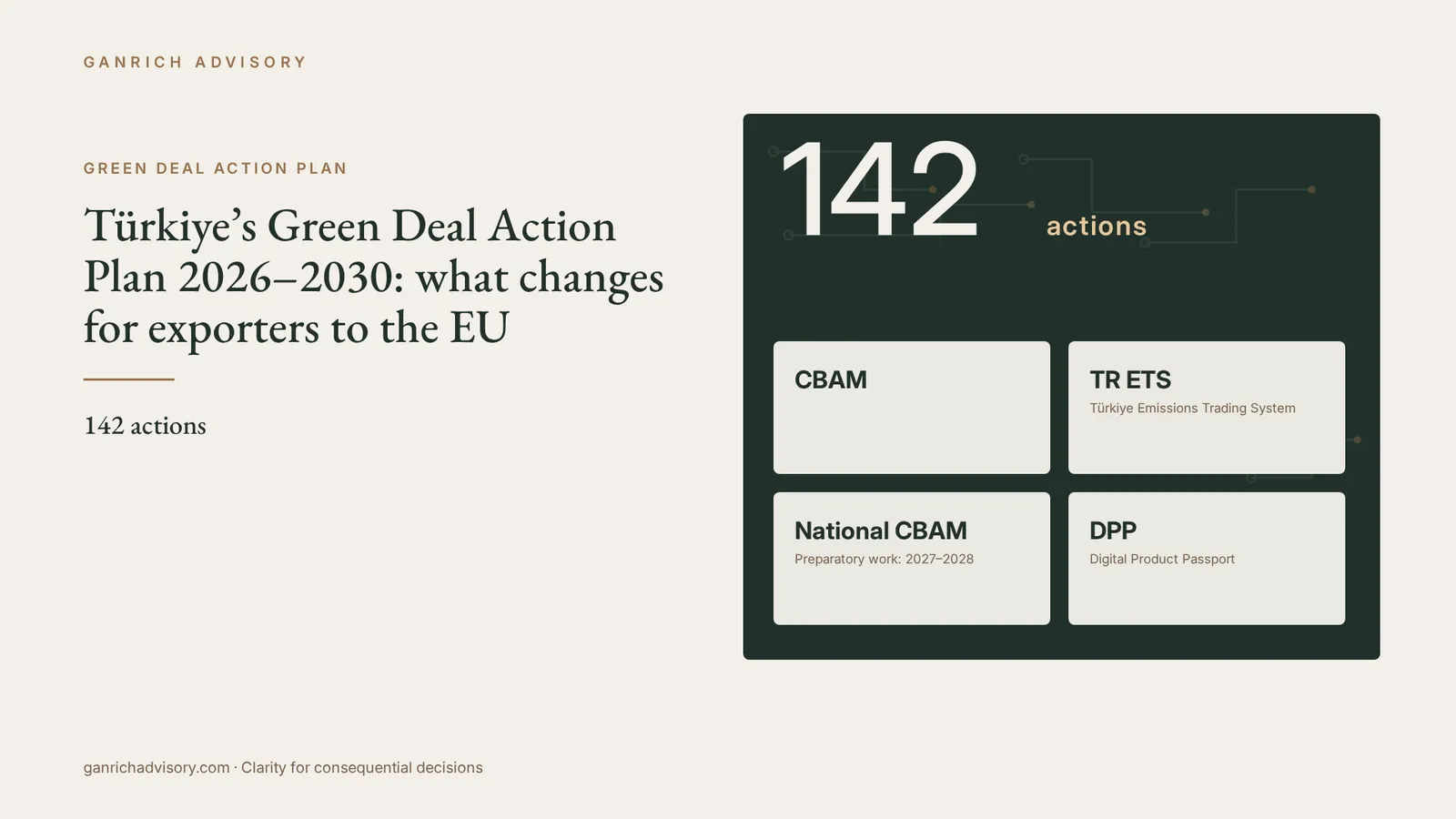
On 10 November 2026, while COP31 was under way in Antalya, Türkiye put its updated Green Deal Action Plan (GDAP) into effect through Presidential Circular No. 2026/12, published in the Official Gazette (No. 33426). The plan was prepared under the coordination of the Ministry of Trade, and the full text is published on the Ministry's website. It replaces the 2021 plan and sets out 11 policy areas, 41 objectives and 142 actions (GDAP 2026–2030).
For an EU buyer or investor, the plan is a clear official signal of where Türkiye's climate-trade policy is going. For a Turkish exporter, a handful of actions matter directly: CBAM data, the Türkiye Emissions Trading System (TR ETS), a possible national CBAM, the Digital Product Passport (DPP) and the EU Deforestation Regulation (EUDR). This article reads the plan from the exporter's side: what it says, when, who leads, and what to do now.
Why the update, and what the trade numbers show
The EU CBAM's definitive phase, with financial obligations, began on 1 January 2026. According to the plan, the EU takes 47% of Türkiye's exports of CBAM-covered goods, and Türkiye is the EU's second-largest supplier of those goods (GDAP 2026–2030, Carbon Pricing Policies chapter).
Early effects are visible. In figures given by Trade Minister Ömer Bolat at Steel Networking Summits 2026 on 26 October 2026, Türkiye's exports of CBAM-covered steel products to the EU fell 1.7% in January–September 2026. Iron and steel exports to the EU overall fell 6.7% (Ministry of Trade, 26 Oct 2026). We set out the context in our CBAM 2026 update.
Those numbers do not prove CBAM alone is diverting trade; quotas, prices and demand moved at the same time. But the direction is clear, and the plan starts from exactly this pressure.
Carbon pricing: 4 objectives, 14 actions
The action timeline lists 14 carbon-pricing actions (1.1.1–1.4.4) under four objectives; the Turkish plan's introductory narrative gives the number as 13 (GDAP 2026–2030, Action Timeline). The ones an exporter should track:
- Sectoral impact of the TR ETS (1.1.1, 2026–2028, Ministry of Environment, Urbanisation and Climate Change): a study of the national carbon price's effect on competitiveness and costs by sector.
- Carbon leakage list (1.1.3, 2027–2030): a method, then a list of high-risk sectors and risk levels, which will shape how sectors are protected under the TR ETS.
- Verification and accreditation (1.1.4, 2026–2030, Ministry of Environment, Urbanisation and Climate Change and TÜRKAK): planning verifier capacity by sector and harmonising TR ETS and CBAM verification criteria, which could spare installations a double verification burden.
- From default to actual values (1.2.3, 2026–2028, Ministry of Trade): access to verified emissions data in CBAM sectors, enough accredited verifiers, and work "to ensure that default emission values converge toward actual emission values".
- Renewable electricity (1.2.4, 2026–2028): pressing the EU to count unlicensed renewable installations in indirect-emissions accounting and to accept YEK-G, Türkiye's renewable energy guarantee-of-origin system, in CBAM Scope 2 calculations.
The plan also states that deducting the TR ETS carbon price from CBAM liability on exports to the EU is expected to support competitiveness. That is an objective, not a working mechanism: the deduction depends on Article 9 of the EU CBAM Regulation and its implementing rules. The Commission adopted the implementing act on 5 November 2026, but it has not yet been published in the Official Journal. We cover the detail in our TR ETS market and registry article.
A national CBAM is now on the agenda
The least discussed item is the objective "Establishing a National CBAM", with two actions led by the Ministry of Trade:
- 1.3.1 (2027): a sectoral impact assessment and the legislative framework for a national CBAM compatible with the TR ETS.
- 1.3.2 (2027–2028): a mechanism similar to the CBAM registry, inter-agency data sharing, analysis of sectors' emissions competitiveness, and "analyzing the embedded emissions of products and identifying potential product groups that could be included in the CBAM scope".
The logic is familiar from the EU: once Turkish producers pay a carbon price under the TR ETS, imports should not undercut them by avoiding it. The plan gives no start date, price or product list; 2027 is a work schedule, not an entry-into-force date. For companies that both export and import products such as steel, aluminium or cement, there are two practical implications: the embedded emissions of your imported inputs may later be required in Türkiye too; and the same dataset you already provide to your EU customer may also be requested in a domestic registry.
Digital Product Passport, ecodesign and customs
The Green and Circular Economy area sets 9 objectives and 31 actions. The plan notes that the Commission's 2025–2030 working plan prioritises 16 product groups, including iron and steel, aluminium, apparel, tyres, furniture and household appliances. For exporters, the key actions are:
- DPP compliance (2.5.2, 2026–2027, Ministry of Trade): negotiating Türkiye's access to the EU DPP database, mapping data and digital-infrastructure needs, and preparing a DPP Compliance Roadmap.
- EU databases (2.3.2, 2026–2028): rules on protecting trade secrets, EU recognition of Turkish e-signatures, and consultations on joining EPREL and the DPP system.
- Ecodesign alignment (2.3.1, 2026–2030): ESPR and the Batteries, Construction Products, End-of-Life Vehicles and Packaging regulations, plus accreditation for notified bodies and test labs.
- Standards (2.3.5): a Turkish Standards Institute (TSE) mirror committee to follow CEN/CENELEC ecodesign work.
- Customs (2.3.3, 2027–2030): integrating customs processes with EU databases and assessing alignment with the EU Single Window Environment for Customs.
None of this changes what your EU customer will ask for in the meantime: the buyer's passport data request will not wait for the Ankara–Brussels database talks. See our steel DPP article for what a steel passport is likely to require.
EUDR: state data is coming, but may not arrive by 30 December
Action 2.5.3 ("as of 2026", Ministry of Agriculture and Forestry with the Ministry of Trade) covers the basic data EUDR sectors need for due diligence, a standard format for national forest and land-use data (geolocation, boundaries, permits, harvesting, production) and verification of forest cover against the 31 December 2020 cut-off.
That will help wood and furniture exporters over time, but the plan sets no completion date, while EUDR applies to large and medium operators from 30 December 2026. For today's obligation, see our EUDR 30 December article.
What the plan does not do
- It creates no new company obligations. It is a coordination document; legal duties come from separate law such as the TR ETS Regulation (Official Gazette 27 Aug 2026, No. 33353) and from EU regulations.
- No date means no date. For the national CBAM, 2027 is when the framework work happens, not when a charge starts.
- Several outcomes depend on Brussels. DPP database access and YEK-G recognition need EU acceptance; the TR ETS deduction depends on EU rules and on meeting their conditions.
Monitoring is defined: under the Circular, the Green Deal Working Group, set up in 2021 and chaired by the Trade Minister or a deputy minister he designates, with deputy ministers from 11 other ministries plus the deputy heads of the Presidency of Strategy and Budget and the Investment and Finance Office and the acting head of the Council of Higher Education, will continue to track progress, and each institution will send an annual progress report to the Ministry of Trade (Circular No. 2026/12, Official Gazette, 10 Nov 2026).
Six steps for exporters now
- Build your emissions data on actual values. The plan makes convergence from defaults to actuals a public goal; your buyers are moving the same way. Test which route costs you less with the CBAM readiness check.
- One dataset, three uses. Use the same installation data for EU CBAM, TR ETS monitoring and a possible national CBAM. Our CBAM data readiness and Türkiye ETS readiness work sets this up.
- Book a verifier early. The plan itself provides for work to reach a sufficient number of accredited verifiers; a squeeze in 2027, before the first CBAM declarations, is plausible.
- Keep your renewable electricity evidence. YEK-G and unlicensed solar records may cut indirect emissions if the EU accepts them, and answer buyer questions either way.
- Ask your input suppliers for embedded emissions. If a national CBAM comes, that will be the first question.
- Plan passport data around customer demand, not around the timing of government talks.
To decide which step comes first for you, see our solutions and the Decision Lab. Our EU regulation calendar tracks every Green Deal deadline.
FAQ
Does the Green Deal Action Plan create new obligations for companies?
Not directly. It assigns tasks and timelines to public bodies. Company obligations come from separate legislation such as the TR ETS Regulation and from EU regulations.
When will Türkiye's national CBAM start?
The plan gives no start date. Action 1.3.1 schedules an impact assessment and legal framework for 2027; action 1.3.2 schedules a CBAM-style registry mechanism for 2027–2028.
Will the carbon price I pay under the TR ETS be deducted from EU CBAM?
That is the plan's aim, but no deduction can be claimed today. It depends on Article 9 of the EU CBAM Regulation; the implementing act setting the calculation and evidence rules was adopted by the Commission on 5 November 2026 (C(2026) 7665) but had not been published in the EU Official Journal as of 11 November 2026.
Do YEK-G certificates reduce indirect emissions under CBAM?
Not yet. Action 1.2.4 commits Türkiye to seek EU acceptance of YEK-G in Scope 2 calculations; the outcome depends on the EU.
Where can I read the full plan?
The Ministry of Trade published it in Turkish and English (PDF) on its Green Deal announcements page.
Sources (accessed 11 November 2026)
- Presidential Circular No. 2026/12 on the Green Deal Action Plan (2026–2030), Official Gazette of Türkiye, 10 Nov 2026, No. 33426: https://www.resmigazete.gov.tr/eskiler/2026/11/20261110-5.pdf
- Ministry of Trade, "Green Deal Action Plan (2026–2030) published", 10 Nov 2026: https://ticaret.gov.tr/dis-iliskiler/yesil-mutabakat/duyurular/yesil-mutabakat-eylem-plani-2026-2030-yayimlandi
- Ministry of Trade, Green Deal Action Plan (2026–2030), full text (PDF, EN): https://ticaret.gov.tr/data/6af2bb11269de173e872a5f6/Green%20Deal%20Action%20Plan%20(2026-2030).pdf
- Ministry of Trade, "Trade Minister Ömer Bolat speaks at Steel Networking Summits 2026" (Turkish), 26 Oct 2026: https://ticaret.gov.tr/haberler/ticaret-bakani-omer-bolat-steel-networking-summits-2026da-konustu
Keep this guide
Get the link and the related PDF in your inbox, to read later or forward to a colleague.
Dates and sources last checked 11 November 2026. General information, not legal advice.