
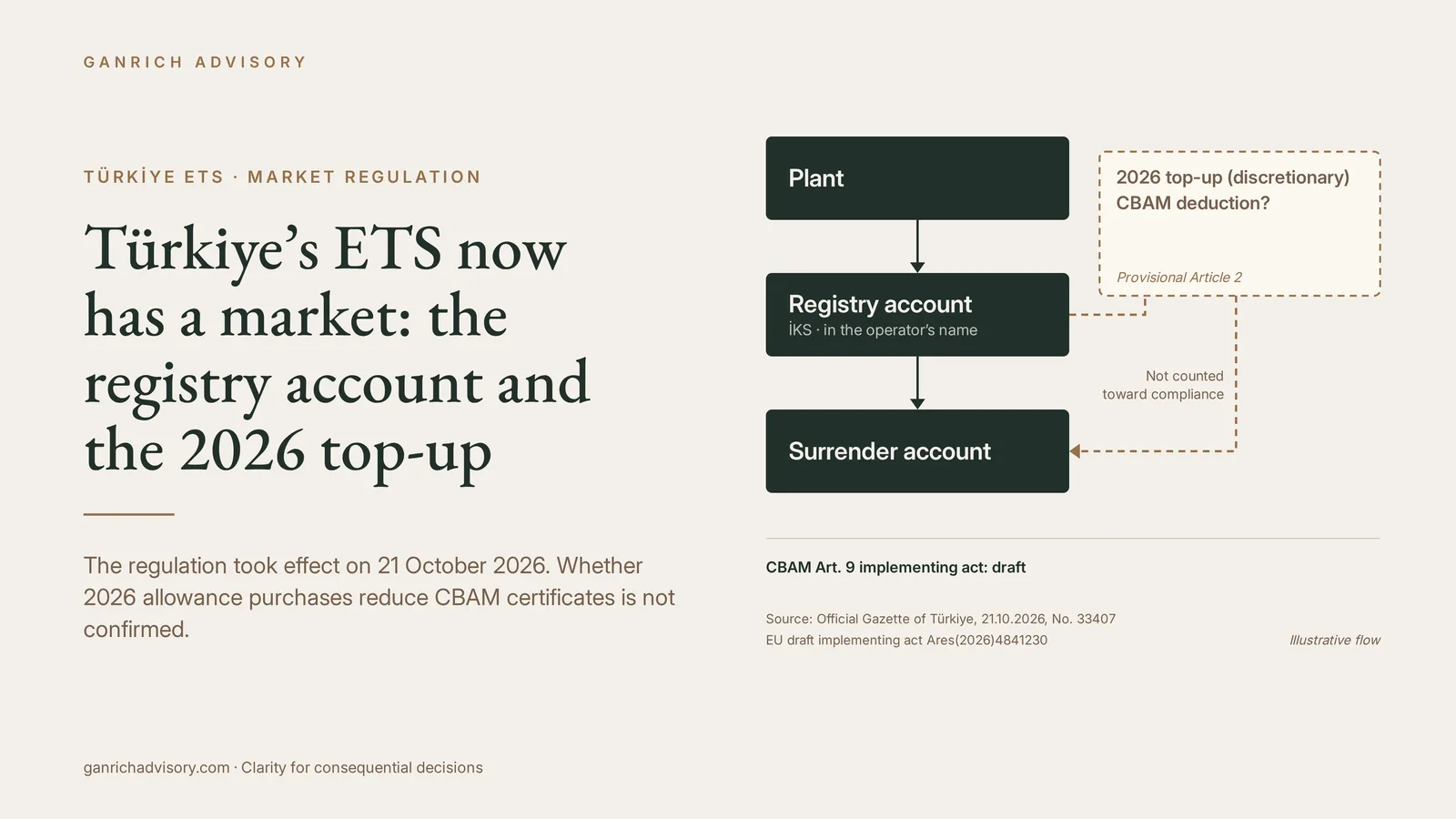
Türkiye's emissions trading system is no longer just a reporting timetable: its market rules are now published. The Energy Market Regulatory Authority's (EPDK) regulation on operating the Türkiye ETS market appeared in the Official Gazette on 21 October 2026 (No. 33407) and took effect the same day (Official Gazette, 21.10.2026; Art. 54). It sets out who runs the market, where allowances are held, how they trade, and one transitional mechanism for 2026 that matters to anyone exporting to the EU. Real trading has not started yet.
For a plant in the pilot, the question has moved on from "when is our monitoring plan due?" to "how do we register, and would buying allowances for 2026 reduce what our EU customers pay under CBAM?" This piece answers both from the official texts and keeps the law separate from our interpretation.
The pilot in brief
According to the Climate Change Presidency's announcement of 1 October 2026, the pilot covers emissions for the 2026 and 2027 system years. Installations above the set emissions threshold in power generation, cement, iron and steel, aluminium and fertilisers are in. 2026 is reporting only; the first surrender obligation applies to 2027 emissions. The detail sits in the Procedures and Principles approved on 30 September 2026 (Approval No. 18626) (Climate Change Presidency, 01.10.2026).
The deadline for first monitoring methodology plans was extended to 27 January 2027 by Approval No. 18814 of 13 October 2026 (Climate Change Presidency, 14.10.2026). We covered that side in our Türkiye ETS pilot monitoring plan report. Here we focus on the market.
Who runs the market and where allowances sit
The market operator is EPİAŞ, Türkiye's energy exchange operator. Trading runs through its ETS Market Management System (ETSPYS) (Arts. 3 and 4). Issuing, holding, transferring, cancelling and surrendering allowances happens in the Transaction Registry System (İKS), in accounts opened in the operator's name; free allocations are credited to those accounts plant by plant (Art. 6).
The market has two layers:
- Primary market: allowances sold for the first time at auction. The lira price set at auction is the Allowance Reference Price (TRF).
- Secondary market: a spot allowance market and, if one is set up, a futures market.
Bids are made in lots of 100 allowances (Arts. 3 and 12), each allowance being one tonne of CO2 equivalent, with prices in TRY per tCO2e in steps of 50 kuruş. Cash settlement and collateral go through a central clearing house established under Capital Markets Law No. 6362.
Until the registry and the primary and spot markets go live, ETSPYS will run a virtual trial with no delivery, invoicing or payment obligations (Provisional Art. 1). That is a cheap way for compliance and treasury teams to learn the bid, collateral and settlement flow before real money is involved.
Opening a registry account
Covered operators must open an İKS account (Art. 7). It is held in the operator's name, and the operator transacts for each of its installations. Operator data flows into ETSPYS from the Climate Change Presidency's monitoring, reporting and verification (MRV) system, so errors in MRV records carry straight into market registration.
Three steps are mandatory:
- Sign a participant agreement with the central clearing house.
- Apply to EPİAŞ through ETSPYS.
- Sign the İKS participation agreement.
The file includes a registration form, original or notarised proof of signing authority, a Trade Registry Gazette extract and the İKS agreement. EPİAŞ reviews the application within 10 business days of filing, then allows 10 business days to fix any gaps; if they are not fixed in time, registration does not go ahead (Art. 8).
In practice, if signing authorities, registry records and MRV plant data don't match, these two windows alone can cost about four weeks. It makes sense to build this file alongside the monitoring plan.
The extra reserve and its price floor
The regulation (Art. 19) provides for an "extra reserve" auction for plants that cannot cover their surrender obligation. It can be used only for compliance, only by decision of the Carbon Market Board, and only up to each plant's shortfall; allowances bought go straight to the plant's surrender account.
That auction has a floor price: 50% above the higher of the three-month weighted average primary price and the three-month weighted average spot price, measured on the last business day of November (if there is no primary price in that window, the spot average is used). The cap is set by EPDK after consulting the Climate Change Presidency. Our reading: a plant that leaves its shortfall to the last minute pays well above the market, so forecasting 2027 allowance needs early is worth real money.
The 2026 top-up price mechanism
Provisional Article 2 opens a separate door for 2026 emissions. If participants request allowances equal to their verified 2026 emissions, plant by plant, a top-up allowance price may apply. In these auctions each participant pays its own bid and no TRF is calculated. The allowances go to the plant's surrender account but are not counted toward meeting the obligation (Provisional Art. 2(3)).
The text says the mechanism "may" apply, not that it will; application, issuance and auction dates are to be set by the Climate Change Presidency (Provisional Art. 2(2)). As of 7 November 2026 the Presidency's announcements list shows none. The Carbon Market Board decision announced on 3 September 2026 says that in 2026 a method for applying the top-up price will be developed and the price mechanism will start from the 2027 system year (Climate Change Presidency, KPK/2026/1). Whether, and when, an auction for 2026 emissions will be held is therefore unclear. A separate, permanent top-up mechanism for allowances that must be surrendered sits in Art. 20.
So a 2026 purchase satisfies no obligation under Turkish law. Why would a company make one?
Ganrich interpretation: in our view the most plausible reason is CBAM. Neither the regulation nor the authorities say so; it is our reading of how the text is built.
Would that payment reduce CBAM costs?
The law (current consolidated text): under Article 9(1) of the CBAM Regulation (EU) 2023/956, as amended by (EU) 2025/2083 (EUR-Lex consolidated text of 20.10.2025), where embedded emissions are determined on the basis of actual emissions, an authorised CBAM declarant may claim a reduction in certificates for the carbon price effectively paid in a third country, taking into account any rebate or compensation there. Article 9(2) requires the documentation to be certified by a person independent of the declarant and of the third country's authorities, plus evidence of actual payment. Under Article 9(4), goods declared on default values can only claim a reduction by reference to yearly default carbon prices. Article 3(29) defines the carbon price to include amounts paid in the form of emission allowances under an emissions trading system (EUR-Lex, consolidated text 20.10.2025).
The implementing act: adopted, Official Journal text not yet confirmed. The draft act on calculating the deduction was opened for feedback on 13 May 2026 as Ares(2026)4841230 (EUR-Lex draft; Commission, 13.05.2026). A Commission Secretariat-General day note records that the College adopted the act by written procedure on 5 November 2026 as C(2026) 7665 (procedure PE/2026/7507). The title is still "Commission Implementing Regulation (EU) …/...", and the note marks it as an act deemed signed for publication (SEC(2026) 275/3, 05.11.2026). EUR-Lex holds a matching record, "C/2026/7665 final", form "implementing regulation", document date 05.11.2026 (EUR-Lex record). As of 10 November 2026, however, the full text still cannot be viewed on EUR-Lex, no Official Journal or CELEX number has been found, and the Commission's CBAM legislation page still does not list the act (the latest implementing act there remains (EU) 2026/1740). Until the authentic Official Journal text is readable, details on calculation, evidence and start of application should be read as proposals in the May 2026 draft, not as settled rules.
Ganrich interpretation: open questions.
- Voluntary purchases. We found no EU text that squarely addresses whether a purchase that doesn't count toward domestic compliance is a carbon price "effectively paid".
- The price itself. A price set by each participant's own bid may draw extra scrutiny on the EU side.
- Compensation. The Carbon Market Board set free allocation at 100% for the pilot (Climate Change Presidency, KPK/2026/1, 03.09.2026). How that is netted off can't be settled until the final implementing text is readable.
So it is too early to plan 2026 allowance purchases as a CBAM saving. The sound move is to prepare the data that would let you decide: product-level actual emissions, verification, proof of payment and independent certification. For 2026 certificate prices and the wider picture, see our CBAM 2026 update.
What covered plants should do now
- Start the İKS file. Make sure signing authority, registry records and MRV plant data agree.
- Join the virtual trial. Learn bids, collateral and settlement in ETSPYS without financial risk.
- Forecast your 2027 shortfall. The extra-reserve floor makes late buying expensive.
- Tie any 2026 purchase to CBAM data. Don't buy until your EU customers' import volumes, your actual emissions data and its verification, and the final implementing act are clear.
- Put the decision in one place. Compliance, finance and export teams should work from the same numbers.
Our Türkiye ETS readiness work turns these steps into a plant-level roadmap. CBAM data readiness covers the EU evidence side and measured energy retrofit the abatement side. Take the CBAM readiness check to see where you stand, and follow EU dates in our EU regulation calendar.
Frequently asked questions
When does the Türkiye ETS market start trading?
The regulation took effect on 21 October 2026. Until the primary and spot markets go live, ETSPYS runs a virtual trial with no payments. Real trading dates will be announced by the authorities.
Is a registry (İKS) account mandatory?
Yes. Covered operators must open one. It is held in the operator's name, and the operator transacts for each installation.
Do plants surrender allowances for 2026?
No. 2026 is reporting only and surrender starts with 2027 emissions. Allowances bought under the 2026 top-up mechanism don't count toward compliance either.
Will 2026 allowance purchases reduce CBAM certificates?
Not yet. Article 9 allows a deduction for a carbon price effectively paid where emissions are declared on actual values. The Commission adopted an implementing regulation on this as C(2026) 7665 on 5 November 2026 (SEC(2026) 275/3, 05.11.2026), but as of 10 November 2026 the Official Journal text has not been confirmed and it is unclear whether voluntary purchases qualify.
What is the monitoring plan deadline?
27 January 2027 (Approval No. 18814 of 13 October 2026).
This article is general information, not legal advice. Regulatory status checked on 10 November 2026.
Sources
- Official Gazette of Türkiye, 21.10.2026, No. 33407, Regulation on Operating the Türkiye ETS Market: index, PDF. Accessed 7 November 2026.
- Official Gazette of Türkiye, 27.08.2026, No. 33353, Türkiye ETS Regulation: text. Accessed 7 November 2026.
- Climate Change Presidency, pilot Procedures and Principles published, 01.10.2026: announcement. Accessed 7 November 2026.
- Climate Change Presidency, monitoring plan deadline extension, 14.10.2026: announcement. Accessed 7 November 2026.
- Regulation (EU) 2023/956 (CBAM), consolidated text of 20.10.2025 incl. (EU) 2025/2083, Articles 3(29) and 9: EUR-Lex. Accessed 7 November 2026.
- European Commission, draft implementing act on carbon price deduction, Ares(2026)4841230, 13.05.2026: EUR-Lex. Accessed 7 November 2026.
- European Commission, SEC(2026) 275/3, day note of decisions adopted by written procedure on 5 November 2026, entry PE/2026/7507 – C(2026) 7665: PDF. Accessed 10 November 2026.
- EUR-Lex record, C/2026/7665 final, document date 05.11.2026 (full Official Journal text not confirmed): record. Accessed 10 November 2026.
- Climate Change Presidency, KPK/2026/1 decisions, 03.09.2026: announcement. Accessed 7 November 2026.
- European Commission, CBAM legislation and guidance: page. Accessed 10 November 2026.
Keep this guide
Get the link and the related PDF in your inbox, to read later or forward to a colleague.
Dates and sources last checked 10 November 2026. General information, not legal advice.