From 9 to 20 November 2026, Antalya hosts COP31, the UN Climate Change Conference (UNFCCC, accessed 3 Nov 2026). Carbon pricing will be in the air. For Turkish exporters of steel, aluminium, cement and fertilisers, though, the most concrete carbon price is not one being negotiated in Antalya. It is the EU's CBAM certificate price, and three of its four 2026 quarters are already published.
Since 1 January 2026 CBAM, the EU's Carbon Border Adjustment Mechanism, has been in its definitive regime (European Commission, accessed 3 Nov 2026). EU importers now carry a financial obligation for the carbon embedded in the goods they buy. The bill for 2026 is paid in 2027, but its size is being set now, shipment by shipment, by the emissions data non-EU producers can or cannot provide.
This update pulls together what changed since our October briefing: the published 2026 prices, the Commission's de minimis review, verifier access to the CBAM Registry, and Türkiye's own emissions trading pilot, which now has a regulation and a procedure behind it.
Why it matters for Türkiye right now
Speaking at Steel Networking Summits 2026, Trade Minister Ömer Bolat said Türkiye's exports to the EU of CBAM-covered steel products fell 1.7% in January–September 2026, and total iron and steel exports to the EU fell 6.7%. He said the EU's 50% quota cut from 1 July 2026 and CBAM were both directly affecting the sector. The EU still takes 42.3% of Türkiye's steel exports. Bolat described the priority as supporting the green transition while making sure exporters do not face disproportionate costs and additional trade barriers (T.C. Ticaret Bakanlığı, 26 Oct 2026).
In other words, this is a market to defend with data, not one to leave.
The 2026 CBAM certificate price, quarter by quarter
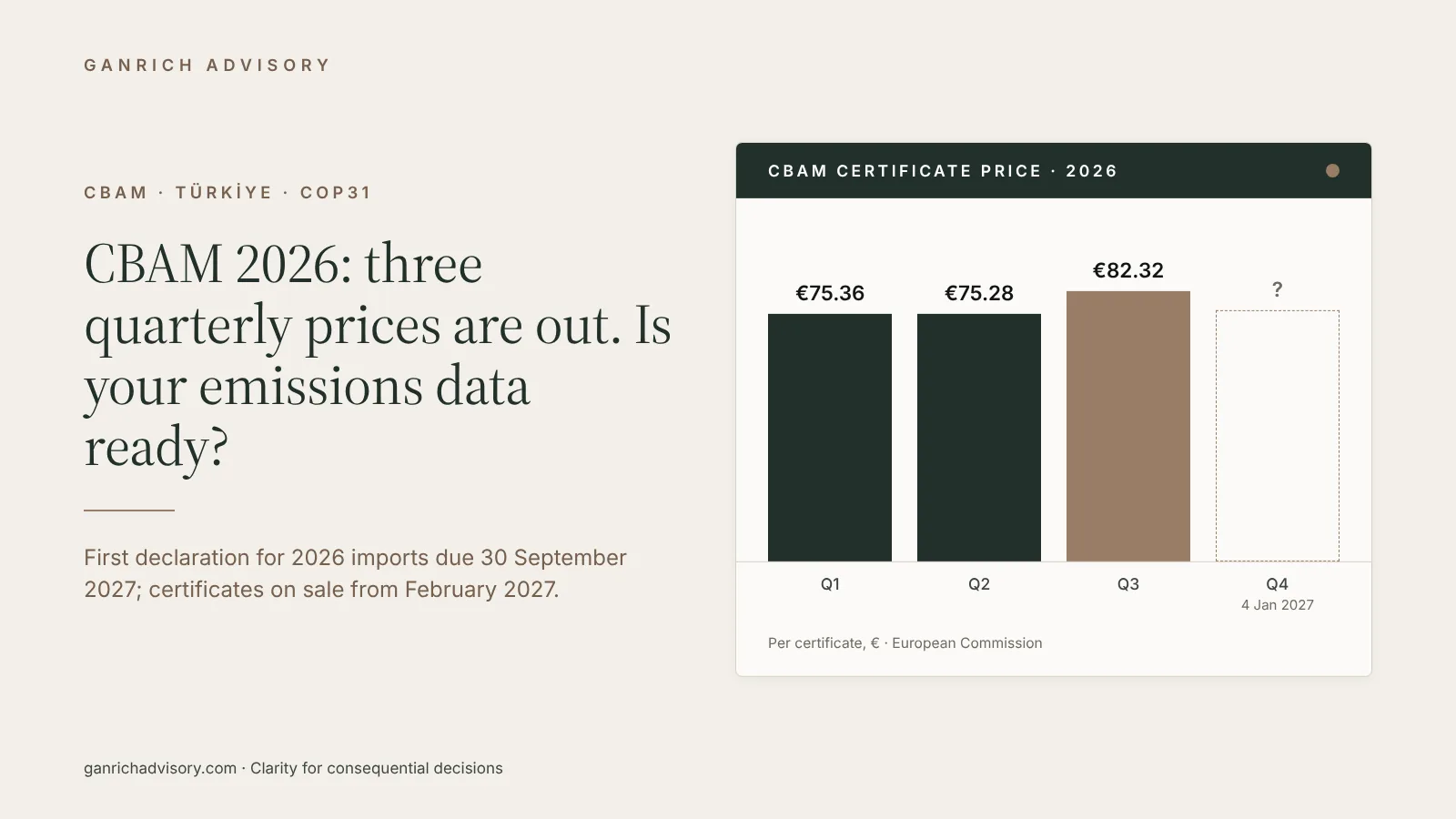
The Commission publishes the 2026 certificate price once per quarter (European Commission, CBAM certificate price page, accessed 3 Nov 2026):
| Quarter (2026 imports) | Price per certificate | Published |
|---|---|---|
| Q1 2026 | €75.36 | 7 Apr 2026 |
| Q2 2026 | €75.28 | 6 Jul 2026 |
| Q3 2026 | €82.32 | 5 Oct 2026 |
| Q4 2026 | not yet published | due 4 Jan 2027 |
The method is set in Implementing Regulation (EU) 2025/2548: the price is calculated from publicly available EU ETS auction information. For 2026 the price is quarterly; from 2027 it becomes weekly (Commission price page; Regulation (EU) 2023/956, Art. 21, as amended by Regulation (EU) 2025/2083). Certificates for 2026 imports go on sale on the central platform from February 2027 (Commission CBAM news page; Ticaret Bakanlığı, accessed 3 Nov 2026).
Two practical points follow. First, the quarter in which goods were imported now has a known price for most of 2026, so an importer can put a number on each 2026 shipment once it has the emissions value. Second, for 2026 only, importers do not have to hold certificates covering 50% of their imports at each quarter end (Ticaret Bakanlığı, accessed 3 Nov 2026). That helps cash flow; it does not reduce what is owed.
Deadlines that have not moved
- 1 Jan 2026: definitive regime starts.
- February 2027: certificate sales for 2026 imports begin.
- 30 Sep 2027: first annual CBAM declaration, covering 2026 imports (Ticaret Bakanlığı, accessed 3 Nov 2026). On 30 Sep 2026 the Commission published a follow-up to its webinar "CBAM from policy to practice – emissions calculation, declarations, and certificates" (Commission CBAM news page).
The 50-tonne rule: reviewed and kept
An importer whose CBAM goods do not cumulatively exceed 50 tonnes net mass in a calendar year is exempt for that year. The threshold covers iron and steel, aluminium, fertilisers and cement, not electricity or hydrogen (Regulation (EU) 2025/2083, Art. 2a).
On 30 September 2026 the Commission published its first assessment of the threshold. For 1 April 2025 to 31 March 2026, the exempted imports represented 0.87% of embedded emissions, below the 1% ceiling the regulation sets (Commission CBAM news page, accessed 3 Nov 2026). For Turkish suppliers the message is simple: small EU buyers may be exempt, but almost all of the embedded emissions still sit with buyers that are not.
Actual emissions vs default values
Embedded emissions are calculated either as actual emissions under the CBAM methodology, or with the Commission's default values. Defaults carry a mark-up of 10% in 2026, 20% in 2027 and 30% in 2028; for fertilisers it is 1% (Ticaret Bakanlığı, accessed 3 Nov 2026). For cement and fertilisers, indirect emissions from electricity count; for iron, steel and aluminium only direct emissions count.
The default values are published on the Commission's CBAM legislation and guidance page. Every producer should compare its own intensity per CN code with the default. If yours is lower, verified actual data is a commercial advantage. If it is higher, the mark-up rises every year and will not protect you for long.
Verification: the bottleneck to book now
Actual emissions must be verified by verifiers accredited by EU accreditation bodies, with on-site installation visits as the priority approach. Legal entities from third countries can also become verifiers (Ticaret Bakanlığı, accessed 3 Nov 2026). Since 1 September 2026 verifiers can access the CBAM Registry, and the Commission published further verifier resources on 28 September 2026 (Commission CBAM news page, accessed 3 Nov 2026).
The working documents remain the ten guidance documents the Commission published on 14 August 2026: general guides No. 1 to 4 and sector guides No. 5a to 5f for cement, hydrogen, fertilisers, iron and steel, aluminium and electricity (DG TAXUD, 14 Aug 2026). Guidance No. 2 and No. 3 cover monitoring plans, system boundaries, activity data and the embedded emissions calculation.
A practical sequence:
- Map every EU-bound product to its CN code and CBAM sector.
- Confirm installation boundaries and production routes against Guidance No. 3 and your sector guide.
- Collect 2026 activity data monthly, not at year end.
- Contract an accredited verifier and plan the site visit.
- Agree in writing with each EU buyer what data you hand over, in what format and when.
Free allocation and the carbon price paid at home
EU producers still receive some free EU ETS allowances, so CBAM adjusts the importer's obligation in the same way. The factor falls each year and reaches zero in 2034 (Ticaret Bakanlığı, accessed 3 Nov 2026). Guidance No. 4 explains the calculation.
The second lever is a carbon price actually paid in the country of production. It can be deducted from the CBAM obligation if it is verified (Ticaret Bakanlığı, accessed 3 Nov 2026). This is where Türkiye's emissions trading system becomes relevant.
TR ETS: what is now in place
The Turkish ETS Regulation was published in the Resmî Gazete on 27 August 2026 (No. 33353) and entered into force on publication (Art. 41). It is based on Climate Law No. 7552 (Art. 3). The regulation gave pilot plants two months from entry into force to submit their first monitoring methodology plans and allowed the Climate Change Directorate to extend this by up to six months (Provisional Art. 3). The Directorate has used that power: by Olur No. 18814 of 13 October 2026 the deadline is now 27 January 2027 (İklim Değişikliği Başkanlığı, 14 Oct 2026).
On 1 October 2026 the Directorate announced the pilot procedures, approved on 30 September 2026 (İklim Değişikliği Başkanlığı, 1 Oct 2026). The pilot covers 2026 and 2027 emissions and installations above the threshold in electricity generation, cement, iron and steel, aluminium and fertilisers. For 2026 there are reporting obligations only. The first surrender obligation applies to 2027 emissions.
What this means for CBAM is a question to approach carefully. The pilot creates monitoring and reporting duties in exactly the CBAM sectors, so one well-built data system can serve both. Whether and how much any Turkish carbon price could be deducted under CBAM depends on the price actually paid and its verification; we do not assume a figure. See our Türkiye ETS readiness page for the pilot steps.
Sector notes
- Iron and steel: the most exposed sector. Bolat said 78% of Turkish capacity is scrap-based electric arc furnace production (Ticaret Bakanlığı, 26 Oct 2026). Any advantage counts only if it is measured and verified; otherwise defaults apply. See Guidance No. 5d.
- Aluminium: direct emissions only. See Guidance No. 5e.
- Cement: indirect emissions from electricity are included, so electricity data matters as much as kiln data. See Guidance No. 5a.
- Fertilisers: a 1% mark-up on defaults, but indirect emissions are included. See Guidance No. 5c.
What to do before year end
- Price your 2026 exposure per buyer: volumes per quarter × emissions per tonne × the published Q1–Q3 prices.
- Compare actual intensity with defaults for each CN code.
- Lock in a verifier for the 2026 data year.
- Align your CBAM monitoring with your TR ETS monitoring methodology plan if your plant is in the pilot.
- Brief the board on 2027: the default mark-up rises to 20% and certificate purchases begin in February 2027.
- If your plant is in the TR ETS pilot, submit your first monitoring methodology plan by 27 January 2027.
Our CBAM readiness check shows where your gaps are. For a structured review of data, monitoring and buyer communication, see CBAM data readiness. For the supplier layer, see supplier sustainability data.
FAQ
What is the CBAM certificate price for 2026?
€75.36 for Q1, €75.28 for Q2 and €82.32 for Q3 2026. The Q4 price is due on 4 January 2027 (European Commission, accessed 3 Nov 2026).
Does a Turkish exporter buy CBAM certificates?
No. The EU importer, as authorised CBAM declarant, buys and surrenders them. The exporter supplies the emissions data that decides how many are needed.
When is the first CBAM declaration due?
By 30 September 2027, for goods imported in 2026.
Is the 50-tonne exemption staying?
The Commission's 30 September 2026 assessment found exempted imports were 0.87% of embedded emissions, below the 1% limit. The rule applies per importer and year and not to electricity or hydrogen.
What happens without actual emissions data?
The importer uses default values plus 10% in 2026, 20% in 2027 and 30% in 2028 (1% for fertilisers).
Does TR ETS reduce CBAM costs?
A verified carbon price actually paid in the country of production can be deducted. The TR ETS pilot requires only reporting for 2026; the first surrender obligation applies to 2027 emissions.
Sources (all accessed 3 Nov 2026 unless stated)
- UNFCCC, COP31 page (Türkiye hosts; COP31 President-designate Murat Kurum, President of Negotiations Chris Bowen of Australia), "UN Climate Change Conference - Antalya, November 2026": unfccc.int/cop31
- European Commission, Price of CBAM certificates: taxation-customs.ec.europa.eu/carbon-border-adjustment-mechanism/price-cbam-certificates_en
- European Commission, CBAM communication and news (de minimis assessment 30 Sep 2026; procedure for verifier Registry access published 28 Aug 2026, access from 1 Sep 2026; verifier resources 28 Sep 2026; webinar follow-up 30 Sep 2026): taxation-customs.ec.europa.eu/carbon-border-adjustment-mechanism/cbam-communication-and-news_en
- European Commission, CBAM definitive regime: taxation-customs.ec.europa.eu/carbon-border-adjustment-mechanism/cbam-definitive-regime_en
- European Commission, CBAM legislation and guidance (default values): taxation-customs.ec.europa.eu/carbon-border-adjustment-mechanism/cbam-legislation-and-guidance_en
- European Commission, DG TAXUD, guidance documents for the definitive period, 14 Aug 2026: taxation-customs.ec.europa.eu/news/european-commission-publishes-series-guidance-documents-support-cbam-implementation-definitive-2026-08-14_en
- Regulation (EU) 2025/2083 of 8 Oct 2025 amending Regulation (EU) 2023/956 (Art. 2a, Art. 21): eur-lex.europa.eu/eli/reg/2025/2083/oj/eng
- T.C. Ticaret Bakanlığı, "AB SKDM Hakkında Genel Bilgiler ve Uygulama Mevzuatı": ticaret.gov.tr/dis-iliskiler/yesil-mutabakat/sinirda-karbon-duzenleme-mekanizmalari/avrupa-birligi-sinirda-karbon-duzenleme-mekanizmasi/ab-skdm-hakkinda-genel-bilgiler-ve-uygulama-mevzuati
- T.C. Ticaret Bakanlığı, "Ticaret Bakanı Ömer Bolat, Steel Networking Summits 2026'da Konuştu", 26 Oct 2026: ticaret.gov.tr/haberler/ticaret-bakani-omer-bolat-steel-networking-summits-2026da-konustu
- Resmî Gazete, Türkiye Emisyon Ticaret Sistemi Yönetmeliği, 27 Aug 2026, No. 33353: www.resmigazete.gov.tr/eskiler/2026/08/20260827-7.htm
- İklim Değişikliği Başkanlığı, "TR ETS Pilot Uygulama Dönemine İlişkin Usul ve Esaslar Yayımlandı", 1 Oct 2026: www.iklim.gov.tr/tr-ets-pilot-uygulama-donemine-iliskin-usul-ve-esaslar-yayimlandi-duyuru-1045
Dates and sources last checked 3 November 2026. General information, not legal advice.