
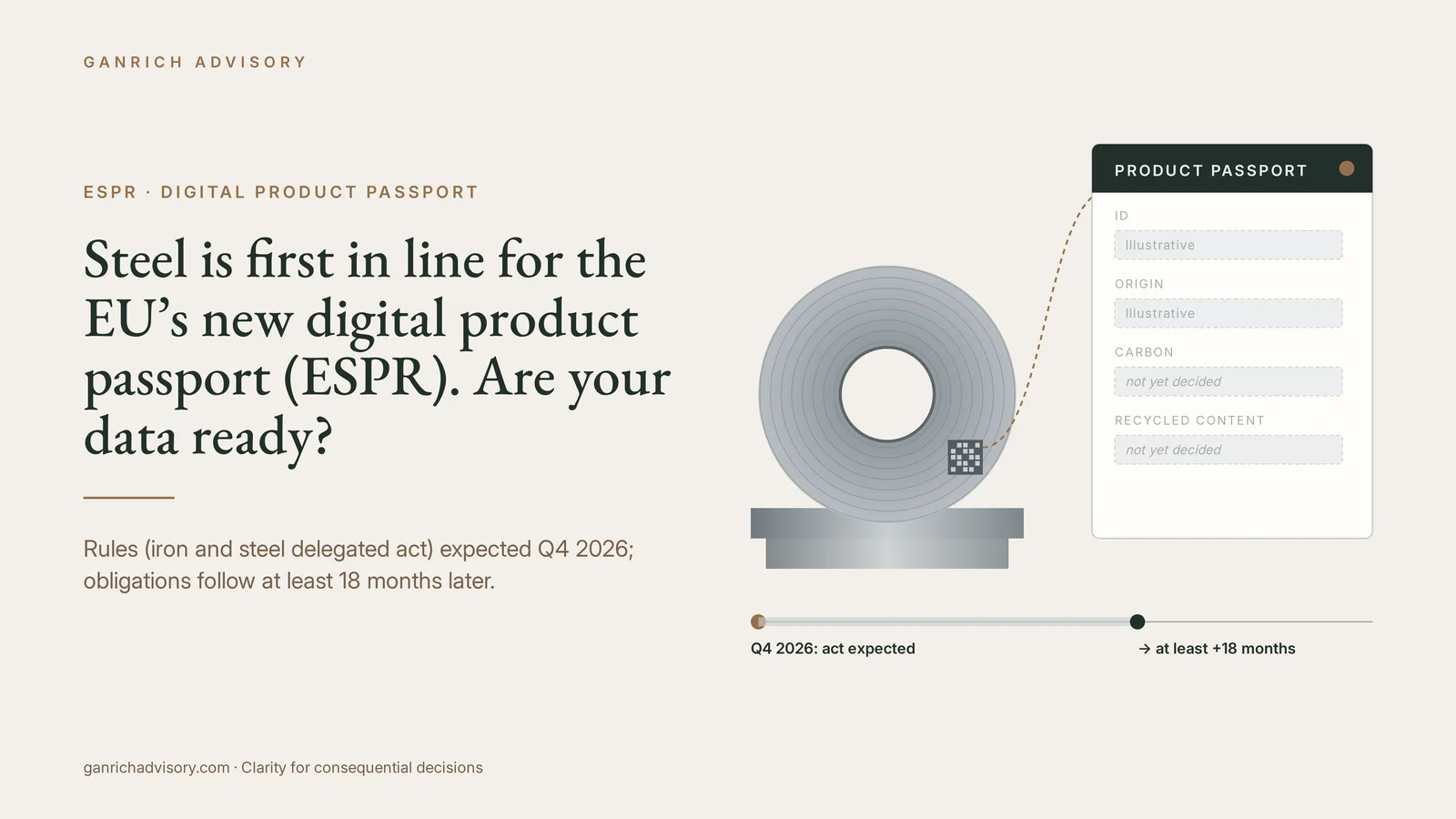
Turkish steel exporters have spent 2026 learning to supply embedded-emissions data to EU CBAM declarants. The next EU data requirement is already on the calendar. The European Commission's Digital Product Passport (DPP) timeline lists the ecodesign delegated act for iron and steel for adoption in Q4 2026, first in line among product groups under the Ecodesign for Sustainable Products Regulation (European Commission, DG GROW, accessed 2 Nov 2026).
This article separates what is decided from what is not, so a steel or metals export manager can plan 2027 without guessing.
What is decided today
- The legal basis. The DPP rests on the Ecodesign for Sustainable Products Regulation, Regulation (EU) 2024/1781 (ESPR). Product-specific DPP requirements come either from ESPR delegated acts or from separate EU laws such as the Batteries Regulation and the Construction Products Regulation (European Commission, DG GROW, accessed 2 Nov 2026).
- The registry. Commission Implementing Regulation (EU) 2026/1778 on the DPP registry was published in the Official Journal on 17 July 2026 (T.C. Ticaret Bakanlığı, DPP page, accessed 2 Nov 2026). The Commission says the registry became operational on 20 July 2026 (European Commission, DG GROW).
- What the registry holds. It stores the unique identifier of each product with mandatory registration data. The full product information is kept by the economic operator or a DPP service provider. A data carrier such as a QR code links the product to its passport, and for imported products the registry's unique registration identifier can be checked at customs (European Commission, DG GROW).
- Standards. The first six DPP standards were published in the Official Journal by July 2026 (Ticaret Bakanlığı); the Commission expects an implementing decision on the remaining two in November 2026 (European Commission, DG GROW).
What ESPR itself already says about the passport
Even without a steel act, the framework regulation fixes the architecture. ESPR's recitals say (Regulation (EU) 2024/1781 of 13 June 2024, recitals):
- The passport should be linked to a unique product identifier and, where appropriate, to a unique operator identifier and a unique facility identifier, so that the actors and manufacturing facilities related to a product can be traced. These identifiers and the data carrier should follow internationally recognised standards.
- The passport should let economic operators, named as manufacturers, authorised representatives, importers, distributors, dealers and fulfilment service providers, access, introduce or update data, without endangering the protection of confidential business information.
- Data should be accurate, complete and up to date, and the passport can be complemented by non-digital information such as a label or product manual.
For a Turkish mill, the facility identifier is the notable point: it ties a product to the plant where it was made, much as CBAM ties emissions to an installation. Whether the steel act requires it is for the act to decide.
Steel is first in line for ESPR, and why it matters for Türkiye
The Commission's list of planned ESPR delegated acts puts iron and steel in 2026, ahead of textiles, tyres and aluminium (2027), furniture (2028), and mattresses and ICT products (2029) (European Commission, DG GROW, accessed 2 Nov 2026).
For Türkiye this is a direct exposure. Turkish mills that ship to the EU already deal with CBAM (our CBAM data readiness service). A steel passport would add a product-level information duty at the point of placing on the EU market.
The difference matters. Under CBAM the declaration duty sits with the EU importer, and the Turkish installation supplies emissions data. Under the DPP the information is tied to the product itself: the data carrier on the product or batch, the registry record and the identifier that customs can check are links in one chain (European Commission, DG GROW). Data readiness is therefore not only a job for the environment or sustainability team; it involves production planning, quality, shipping and IT. Which data sit with whom, how they are shared with the EU buyer and how commercially sensitive data are protected are questions to start discussing now.
Timeline: what comes when
The Commission publishes an indicative timeline, subject to change (European Commission, DG GROW, accessed 2 Nov 2026):
| When | What |
|---|---|
| 20 Jul 2026 | DPP registry operational |
| Nov 2026 | Implementing decision on the remaining two DPP standards |
| Q4 2026 | Adoption of the ESPR delegated act for iron and steel |
| 18 Feb 2027 | DPP mandatory for certain batteries (EV, light means of transport, industrial) |
| Q2-Q3 2027 | Delegated act for DPP service providers (Ticaret Bakanlığı: Q3 2027) |
| Q3-Q4 2027 | Delegated acts for textiles, aluminium and tyres |
| 2028 | Furniture |
The key planning rule: after an ESPR delegated act is adopted, economic operators get a transition period of at least 18 months (European Commission, DG GROW). If the steel act is adopted in Q4 2026, obligations would not apply before mid-2028 at the earliest, and later if adoption slips (Ganrich calculation from the Commission's indicative dates; the actual date will be set in the act).
What a steel passport is likely to hold, and what is still open
| Decided | Not decided (as of 2 Nov 2026) |
|---|---|
| Legal basis (ESPR) and registry rules | Exact data fields for steel |
| Iron and steel is first in line among ESPR delegated acts, planned Q4 2026 | Whether performance thresholds (e.g. for carbon) are set, and at what level |
| Transition of at least 18 months after adoption | Which steel products and CN codes are in scope |
| Product identifier + data carrier + customs check of the registry identifier | Whether information is per batch, per product model or per installation |
The Commission says a DPP may, depending on the product group, include information on safety, origin, materials, repairability, environmental performance, reuse and recycling (European Commission, DG GROW). For steel specifically, the Commission's call for evidence (published 20 May 2026, Have Your Say initiative 17672) lists the policy options under assessment: information requirements on the carbon footprint of iron and steel products, on recycled content and on substances that make them harder to recycle; performance classes and minimum environmental performance thresholds, based for example on carbon footprint; and digital product passport requirements for all actors in the supply chain. The initiative will also define "low-carbon steel" for the Industrial Accelerator Act. As of 2 November 2026, no draft act had been published for feedback (Have Your Say initiative 17672; secondary: Publicea, 28 Oct 2026).
How DPP and CBAM data overlap
This section is Ganrich analysis, not a regulatory fact. CBAM already requires installation-level embedded emissions for steel. If the steel delegated act includes a carbon-footprint field, mills that already have verified CBAM monitoring will likely start ahead. The methods may differ (CBAM embedded emissions versus a product footprint method), so do not assume one number will serve both. Build one emissions data set that can be traced to source, and keep the method choices documented.
What the Turkish Ministry of Trade is telling exporters
The Ministry of Trade has a DPP information page on EU technical regulation alignment (accessed 2 Nov 2026) and published a DPP frequently-asked-questions document on 24 June 2026. On 15 October 2026 the Ministry of Trade opened a DPP question-collection survey (Ministry of Trade, announcement, 15 Oct 2026), which TOBB relayed to chambers on 20 October 2026. If you received it, it is worth answering: it is how Turkish industry's questions reach the authorities.
Five things to prepare in 2027
- Product inventory: list EU-bound steel products by CN code, grade and mill, so scope can be checked the day the act is published.
- Identifiers: decide how you will give each product or batch a unique identifier and data carrier (marking, labels, certificates).
- Emissions data: keep CBAM monitoring running at verified quality; it is your best base for any carbon field.
- Recycled content: document scrap inputs and their sources by heat or batch.
- Service provider decision: decide whether you will host passport data yourself or use a DPP service provider; rules for providers are expected in 2027.
Our supplier sustainability data work and the textile product passport report show how this works in practice; for batteries see battery passport readiness. Track dates on the EU regulation calendar.
FAQ
Is a Digital Product Passport mandatory for steel today?
No. Obligations start only after the iron and steel delegated act is adopted and its transition period of at least 18 months ends (European Commission, DG GROW, accessed 2 Nov 2026).
What is the first mandatory DPP?
Certain batteries, from 18 February 2027 (European Commission, DG GROW).
When is the steel act expected?
Q4 2026 on the Commission's indicative timeline.
Does the EU registry store all our product data?
No. It stores unique identifiers and mandatory registration data; full product information is held by the operator or a DPP service provider (European Commission, DG GROW; Implementing Reg. (EU) 2026/1778).
Will customs check the passport?
For imported products, the registry's unique registration identifier can be checked at customs (European Commission, DG GROW; Ministry of Trade).
Will our commercially sensitive data be public?
Access will be managed by user role (DG GROW); the steel act will decide which field is open to whom.
Has a draft steel act been published?
No. As of 2 November 2026, no draft had been published for feedback (Have Your Say initiative 17672). Recheck on publication day.
Will our CBAM emissions data be reused?
Not decided. It is a likely starting point, but that is our analysis, not EU text.
Which steel products are in scope?
Not decided until the act is published.
Who builds the passport, us or our EU buyer?
Under ESPR, the manufacturer must ensure a passport is available (Art. 27(1)(c)), and the importer must ensure the same before placing the product on the market (Art. 29(2)(c)) (Regulation (EU) 2024/1781). For a Turkish mill selling into the EU, that means the passport is in practice built from your data, even when your EU importer is the one placing it on the market. What the steel passport must contain will be set in the act.
Next step: take the CBAM readiness check, which covers the emissions data a steel passport is likely to build on.
Sources
- European Commission, DG GROW, "Digital Product Passport" (accessed 2 Nov 2026): single-market-economy.ec.europa.eu/single-market/digital-product-passport_en
- Regulation (EU) 2024/1781 (ESPR) of 13 Jun 2024, OJ 28 Jun 2024 (text read 2 Nov 2026): eur-lex.europa.eu/eli/reg/2024/1781/oj
- Commission Implementing Regulation (EU) 2026/1778 (OJ 17 Jul 2026, per Ticaret Bakanlığı): eur-lex.europa.eu/eli/reg_impl/2026/1778/oj
- T.C. Ticaret Bakanlığı, "AB Dijital Ürün Pasaportu" (accessed 2 Nov 2026): ticaret.gov.tr/urun-guvenligi/ab-teknik-mevzuat-uyumu/dijital-urun-pasaportu
- T.C. Ticaret Bakanlığı, "Dijital Ürün Pasaportu Sıkça Sorulan Sorular Dokümanı" (24 Jun 2026): ticaret.gov.tr/dis-iliskiler/yesil-mutabakat/duyurular/dijital-urun-pasaportu-sikca-sorulan-sorular-dokumani
- European Commission, Have Your Say initiative 17672, "Ecodesign requirements for iron and steel products" (call for evidence 20 May 2026; checked 2 Nov 2026, draft act stage "upcoming", feedback not open): ec.europa.eu/info/law/better-regulation/have-your-say/initiatives/17672
- T.C. Ticaret Bakanlığı, "AB Dijital Ürün Pasaportu (DPP) Soru Toplama Anketi" (15 Oct 2026): ticaret.gov.tr/urun-guvenligi/duyurular/ab-dijital-urun-pasaportu-dpp-soru-toplama-anketi (survey: anketler.ticaret.gov.tr/anket-cevapla/405)
- TOBB letter to chambers, "AB Dijital Ürün Pasaportu - Soru Toplama Anketi" (20 Oct 2026), as published by Mardin TSO: mardintso.org.tr/rscms/uploads/2026/10/AB-Dijital-Urun-Pasaportu-Soru-Toplama-Anketi.pdf
- Secondary: Publicea (28 Oct 2026).
Dates and sources last checked 2 November 2026. General information, not legal advice.