
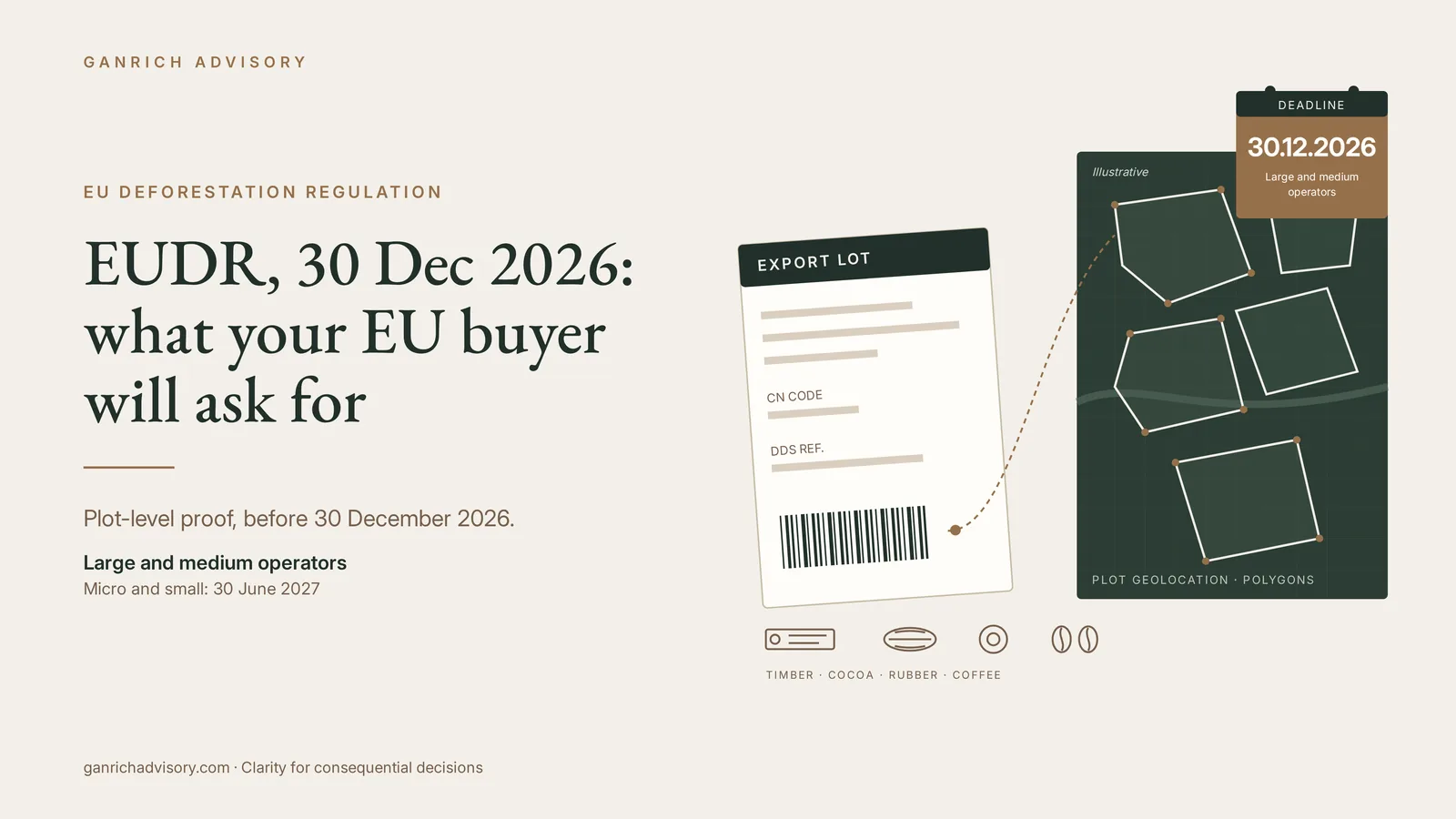
If your EU customer has started sending questionnaires about "EUDR", "geolocation" or a "DDS reference", you are not alone. After two postponements, the EU Deforestation Regulation, Regulation (EU) 2023/1115, now applies to large and medium operators from 30 December 2026 (European Commission, DG ENV, accessed 2 Nov 2026). That is about eight weeks from the planned publication date.
Most of what is written about EUDR is addressed to the EU importer. This article is written for the other side of the table: the Turkish exporter, processor or supply-chain manager who has to produce the evidence. It is cross-sector. For wood and furniture specifically, see our EUDR checklist for Turkish wood and furniture exporters.
What changes on 30 December 2026 (and who gets until 30 June 2027)
The European Commission's EUDR page, checked on 2 November 2026, lists these application dates (European Commission, DG ENV, accessed 2 Nov 2026):
- Large and medium operators: 30 December 2026.
- Micro and small operators: 30 June 2027.
- Micro and small operators already covered by the EU Timber Regulation (EUTR): 30 December 2026.
These dates are the result of two amendments. The first, Regulation (EU) 2024/3234 of 19 December 2024, delayed the original December 2024 start by a year (EUR-Lex). The second, Regulation (EU) 2025/2650 of 19 December 2025, was published in the Official Journal on 23 December 2025 and entered into force on 26 December 2025 (European Commission, DG ENV newsletter, Dec 2025).
Practically: your EU buyer, if it is a large or medium company, must be able to show on 30 December 2026 that the relevant goods it places on the EU market are compliant. Its data request to you is therefore due well before that date.
Which Turkish exports are caught: commodities and CN codes, not trade names
EUDR covers seven commodities: cattle, cocoa, coffee, oil palm, rubber, soya and wood, plus listed derived products such as chocolate, tyres, paper and furniture (European Commission, DG ENV, accessed 2 Nov 2026). Scope is decided by the customs codes in Annex I of Regulation (EU) 2023/1115, not by what the product is called in your catalogue (Reg. (EU) 2023/1115, Annex I as amended by Delegated Regulation (EU) 2026/2102, OJ 17 Sep 2026).
Check every product line you ship to the EU against Annex I using its CN code. Typical Turkish hits include sawn wood, panels, pulp, paper and printed matter, wooden furniture, tyres and other natural-rubber products, and processed cocoa or coffee. Cattle hides and leather are no longer on the list (see below).
Who files what: operator, downstream operator, trader
The regulation puts the due diligence duty on the operator, the person who first places a relevant product on the EU market or exports it from the EU. The operator submits a due diligence statement (DDS) in the EU Information System, which the Commission launched on 4 December 2024 (European Commission, DG ENV, accessed 2 Nov 2026).
In most Turkish export flows, the EU importer is the operator and files the DDS. Your job is to give it the data it needs. Three points need care:
- If your Turkish company, or an EU entity in your group, itself places goods on the EU market, it may carry operator duties directly.
- Where a company established outside the EU places products on the EU market, the first person established in the EU that makes them available is deemed to be the operator (Reg. (EU) 2023/1115, Art. 7).
- The December 2025 amendment, Regulation (EU) 2025/2650 of 19 December 2025, created a new category of "downstream operator". Downstream operators and traders no longer submit due diligence statements; the first downstream operator or trader must collect and keep DDS reference numbers (Reg. (EU) 2025/2650, recitals 4-5).
In practice, this means not every EU firm that buys and processes your goods will ask you for data separately; the request will come mainly from the first operator, usually your direct customer. But that customer will expect a complete and consistent pack from you to stand behind its own statement.
The data pack your EU buyer will ask for
Under Regulation (EU) 2023/1115, a product may be placed on the EU market only if it is deforestation-free, produced in accordance with the relevant legislation of the country of production, and covered by a due diligence statement (Reg. (EU) 2023/1115, Art. 3). "Deforestation-free" uses a cut-off date of 31 December 2020 (Reg. (EU) 2023/1115, Art. 2). Expect your buyer to ask for:
- Product identification: description, CN code, quantity, and the country of production.
- Geolocation of all plots of land where the commodity was produced, as points or, for larger plots, polygons (Reg. (EU) 2023/1115, Art. 9). Coordinates need at least six decimal digits; plots of more than four hectares, for commodities other than cattle, must be given as polygons describing the perimeter.
- Evidence that the land was not deforested after 31 December 2020, for example satellite-based checks against the plots.
- Legality evidence: documents showing production complied with relevant laws in the country of production, such as land-use rights, forestry and environmental rules, labour and tax rules.
- Supplier chain information: names and addresses of suppliers and of the customers you sell to.
- A DDS reference number if an earlier operator in the chain has already filed one, so the buyer can refer to it. Operators must pass DDS reference numbers, or declaration identifiers, down the supply chain (Reg. (EU) 2023/1115, Art. 4(7) as amended by Reg. (EU) 2025/2650). At the border, the DDS reference number or declaration identifier must be made available to customs before release for free circulation or export, normally by the person lodging the customs declaration (Art. 26(4) as amended). So the reference number should sit in the shipment file with the invoice and origin documents.
The hard part is rarely the form. It is getting plot-level geolocation from the start of a chain you do not control.
Sector notes for Türkiye
- Wood, pulp and paper: much Turkish timber, pulp and paper is imported, so geolocation must come from the original forest supplier abroad. Map where each input batch comes from. Our wood and furniture checklist covers this in detail.
- Leather: cattle hides, skins and leather (ex 4101, 4104, 4107) were removed from Annex I by Delegated Regulation (EU) 2026/2102, in force since 18 September 2026. Check remaining cattle codes, such as live cattle and meat, at eight-digit level.
- Rubber and tyres: natural rubber is imported, mostly from Southeast Asia. Tyres remain in scope; several technical-rubber codes (belts, ex 4016) were removed in September 2026 (Delegated Reg. (EU) 2026/2102). Check each code.
- Cocoa and coffee processors: chocolate makers and roasters need plot data for every origin. Note the new scope from December 2027 below.
What the December 2025 amendment simplified, and what it did not
The text of Regulation (EU) 2025/2650 shows three points that matter to exporters: downstream operators and traders no longer file DDSs; "micro or small primary operators", meaning micro or small producers established in a country classified as low risk that place their own produce on the market, submit a one-time simplified declaration and receive a declaration identifier; and the first downstream actor must collect reference numbers and declaration identifiers (Reg. (EU) 2025/2650, recitals 4-6). The 30 June 2027 date applies to micro and small undertakings established as such by 31 December 2024, except for products covered by the EU Timber Regulation (amended Art. 38(3)).
Türkiye is classified low risk (Implementing Reg. (EU) 2025/1093). That allows simplified due diligence only for commodities produced in Türkiye, not for imported timber, pulp or rubber processed here.
The conversation to have with your EU buyer
The Regulation requires the operator, before placing a product on the market, to collect information, assess risk and, where needed, mitigate it (Reg. (EU) 2023/1115, Art. 8). Your customer will build all of these steps on the information you provide, so start the conversation yourself instead of waiting for their form:
- Format: their own portal, a spreadsheet template or a GeoJSON file? In what format do they want coordinates?
- Batch matching: do they expect location data per shipment, per order or per year? Where inputs of different origins are mixed in one batch, do they want all possible plots?
- Confidentiality: your supplier names and plot data have commercial value. Put in the contract that shared data will be used only for compliance.
- Liability: review together what happens if the data turn out to be wrong, and the warranty and indemnity clauses in the contract.
New scope from 30 December 2027
Commission Delegated Regulation (EU) 2026/2102 adds new products to EUDR scope from 30 December 2027, including soluble coffee, certain palm oil derivatives and frozen cattle tongues (European Commission, DG ENV, accessed 2 Nov 2026). Food exporters who assumed they were outside EUDR should recheck their CN codes against the delegated act.
An eight-week action list
- Week 1: map every EU-bound product line to its CN code and check it against Annex I.
- Week 1-2: ask each EU buyer in writing what format they want: their own portal, a spreadsheet, or a DDS reference.
- Week 2-4: collect plot geolocation and legality documents from upstream suppliers; flag gaps by supplier.
- Week 3-6: run deforestation checks on plots against the 31 December 2020 cut-off, or confirm who will.
- Week 5-8: build a repeatable batch-level file that links each shipment to its plots and documents.
- Throughout: recheck the Commission page for any change; we last confirmed the dates on 2 November 2026.
Track related deadlines on our EU regulation calendar, and see how we organise supplier data in supplier sustainability data.
FAQ
Does a Turkish exporter file the due diligence statement?
Usually not. Where a non-EU company places goods on the EU market, the first EU-established person making them available is deemed the operator (Reg. (EU) 2023/1115, Art. 7), and that operator files the DDS in the EU Information System. Your job is the data.
Is an FSC or PEFC certificate enough?
Do not assume so. The regulation requires geolocation, a deforestation-free check against 31 December 2020, and legality evidence (Reg. (EU) 2023/1115, Arts. 2, 3, 9). The regulation says certification or other third-party verified schemes can be used in risk assessment but should not substitute the operator's responsibility for due diligence (Reg. (EU) 2023/1115, recital 52).
Are goods ordered before 30 December 2026 exempt?
Not automatically. What counts is when goods are placed on the EU market. One specific transitional rule: timber and timber products produced before 29 June 2023 and placed on the market from 30 December 2026 stay under the EU Timber Regulation until 31 December 2029 (Reg. (EU) 2023/1115, Art. 37 as amended by Reg. (EU) 2025/2650).
Not sure where you stand? Take the EUDR readiness check or book an EUDR traceability review.
Sources
- European Commission, DG ENV, "Regulation on Deforestation-free products" (accessed 2 Nov 2026): environment.ec.europa.eu/topics/forests/deforestation/regulation-deforestation-free-products_en
- European Commission, DG ENV newsletter, "EU Deforestation Regulation updates – Final text of EUDR is now published online" (Dec 2025; in force 26 Dec 2025): ec.europa.eu/newsroom/env/newsletter-archives/70716
- Regulation (EU) 2023/1115 (31 May 2023), EUR-Lex (text read 2 Nov 2026): eur-lex.europa.eu/eli/reg/2023/1115/oj
- Regulation (EU) 2024/3234 (19 Dec 2024), EUR-Lex: eur-lex.europa.eu/eli/reg/2024/3234/oj
- Regulation (EU) 2025/2650 of 19 Dec 2025 (OJ 23 Dec 2025), EUR-Lex (text read 2 Nov 2026): eur-lex.europa.eu/eli/reg/2025/2650/oj
- Commission Delegated Regulation (EU) 2026/2102 of 13 July 2026 (OJ L, 17.9.2026), EUR-Lex: eur-lex.europa.eu/eli/reg_del/2026/2102/oj (read live 2 Nov 2026)
- Commission Implementing Regulation (EU) 2025/1093 (country classification; Türkiye listed low risk), EUR-Lex: eur-lex.europa.eu/eli/reg_impl/2025/1093/oj/eng (read live 2 Nov 2026)
Dates and sources last checked 2 November 2026. General information, not legal advice.