
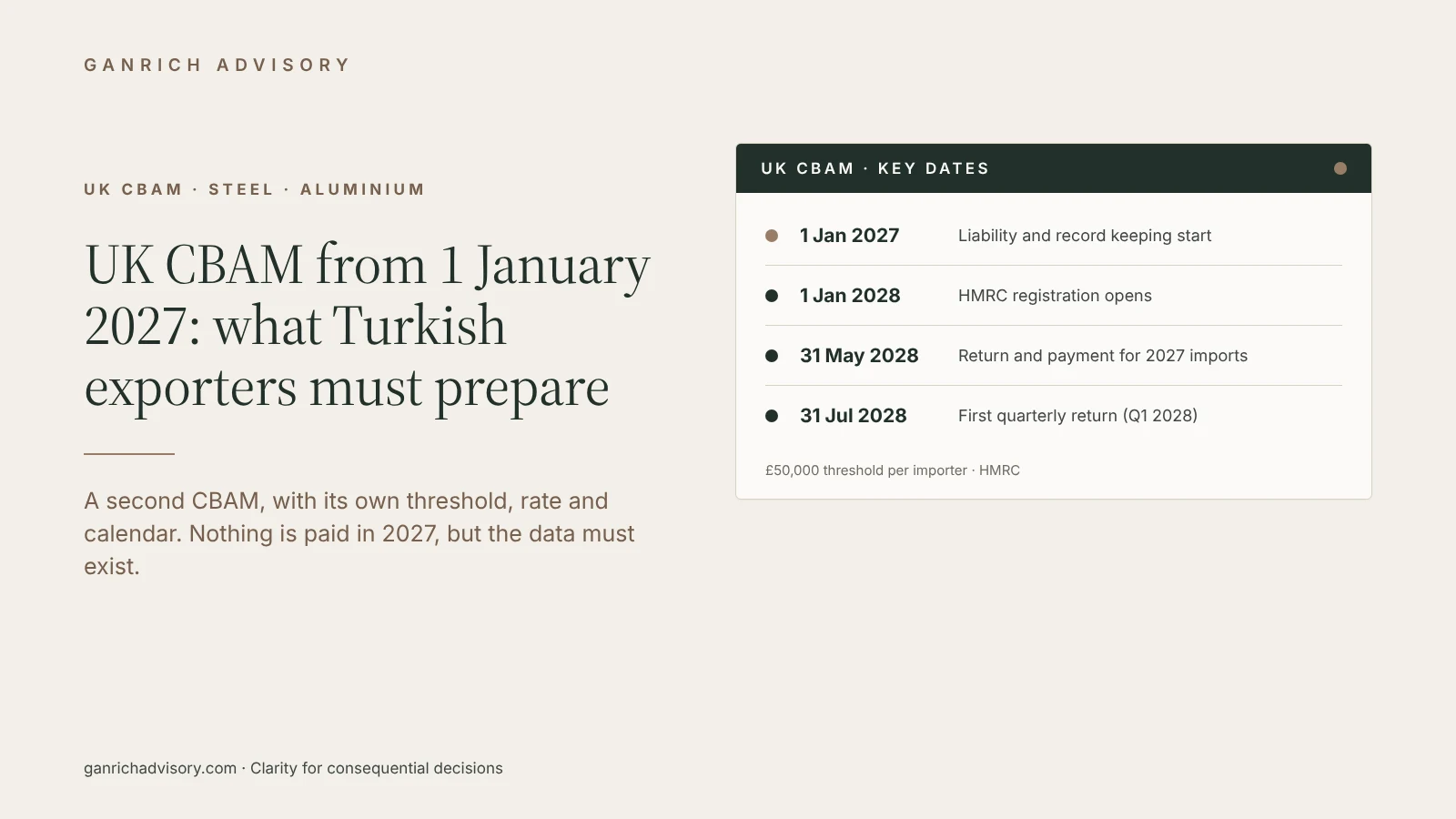
Turkish steel and aluminium exporters spent 2026 on EU CBAM data. A second CBAM starts in seven weeks: the UK's applies to aluminium, iron and steel, cement, fertiliser and hydrogen goods imported into the UK on or after 1 January 2027 (HMRC, CBAM policy summary, updated 2 Nov 2026).
It is not a copy of the EU system: threshold, calendar, rate and the treatment of a home carbon price all differ.
What starts on 1 January 2027, and what does not
- From 1 January 2027: liability; record keeping (code, tax point date, value, weight, exemption evidence; £500 fixed penalty if records are not kept); quarterly sector rates (HMRC policy summary; Keeping records for CBAM, updated 3 Nov 2026; Rates for CBAM, 16 Oct 2026).
- Later: registration opens 1 January 2028 (first-year deadline 31 January 2028); the return and payment for all of 2027 are due by 31 May 2028; quarterly returns follow, Q1 2028 due by 31 July 2028 (HMRC policy summary, Table 2).
Nothing is paid in 2027. But once an importer's CBAM imports cross the £50,000 threshold, every in-scope shipment from that point is chargeable, and its emissions data must exist when the importer files in 2028. Goods imported while an importer is below the threshold, neither registrable nor registered, are not charged (Finance Act 2026, section 147).
Goods in scope: by UK commodity code
Only listed commodity codes are "CBAM goods" (HMRC, Check which goods are in scope, 16 Jul 2026); aluminium and iron and steel scrap is excluded. The charge covers direct emissions plus emissions embodied in precursors, so purchased billet or slab emissions follow a rolled product (HMRC policy summary). Check codes against the HMRC lists; do not assume your EU mapping carries over.
Who is liable: the UK importer, and when that is you
The liable person is the importer: the person in whose name the customs declaration is made, or on whose behalf it is made (Finance Act 2026, section 146). Usually that is the UK buyer.
- If you sell DDP and the UK import declaration is made in your name or on your behalf, you are the importer and the CBAM liability is yours. The Finance Act 2026 (section 146) makes the importer liable, and HMRC says this applies whether the importer is established in the UK or outside it. Using a customs broker or freight forwarder to lodge the declaration does not move the liability to them. If your own UK imports of CBAM goods reach the £50,000 threshold, you must register with HMRC yourself: registration uses a Government Gateway account and asks for an EORI number. A tax agent can file returns for you but cannot register for you and carries no liability. Because the test counts all of your own imports, DDP sales to several UK customers add up.
- Even when the buyer is liable, the data comes from you: actual emissions need verified intensity from your installation (HMRC policy summary).
UK vs EU CBAM side by side
| UK CBAM | EU CBAM | |
|---|---|---|
| Start of charge | 1 Jan 2027 | Definitive regime from 1 Jan 2026 |
| Threshold | £50,000 of CBAM goods by value, per importer (30-day forward or 12-month look-back test); no charge below it | 50 tonnes net mass per importer per year |
| Who files | Importer (liable person), UK or non-UK established; may appoint a tax agent to file returns | Authorised CBAM declarant |
| Price | Sector rate published quarterly: UK ETS auction price minus a free-allocation adjustment | Certificate price, quarterly in 2026, weekly from 2027 |
| First payment | Return and payment by 31 May 2028 for 2027 imports | First declaration by 30 Sep 2027 for 2026 imports |
| Defaults | One default value per good, regardless of origin | Commission defaults, mark-up 10% (2026), 20% (2027), 30% (2028) |
EU column as verified in our CBAM 2026 update.
HMRC's illustrative rates, published 16 October 2026 and based on the Q3 2026 average UK ETS price of £58.15, were £9.69 per tCO2e for iron and steel and £9.79 for aluminium. HMRC stresses these are not forecasts (HMRC, Illustrative CBAM rates, 16 Oct 2026). HMRC says the underlying data is likely to change before 1 January 2027 and the figures create no tax liability. The Q1 2027 rate will use the Q4 2026 UK ETS auction average (Finance Act 2026, s149). The low figure comes from the free-allocation adjustment, which currently removes about 83% of the ETS price.
The £50,000 threshold is tested by value, not weight: 30 days forward from any day, or 12 months back on the first day of each month (Finance Act 2026, Sch 17 para 2). The threshold applies per importer, across all its CBAM imports made in the course of business, and only imports from 1 January 2027 count.
The data pack a UK buyer will ask for
- Installation identity, production route and precursor data per product.
- Verified emissions intensity per good for a calendar year: for 2027 imports, 2027 data if available, otherwise 2026, or the production year (HMRC policy summary, Options 1 and 2).
- A verification report or good-specific summary, kept by the importer for six years (HMRC, Verifying emissions data, 16 Oct 2026; Keeping records for CBAM).
- Weight and value records matching the import declaration.
Two rules deserve attention. First, if an importer files a return with default values, it cannot amend it later with actual data (HMRC, Iron and steel default values, 16 Oct 2026). Second, if your buyer wants to use actual data, the verifier must be accredited for UK CBAM against ISO/IEC 17029 and ISO 14065 by an eligible accreditation body, must have the right sectoral scope and must be independent of the installation (HMRC, Verifying emissions data). The verifier does not have to be British. An eligible accreditation body is a full member of the Global Accreditation Cooperation (Global ACI) that has been peer-evaluated for those standards, and it normally accredits verifiers in its own country (HMRC, Responsibilities if you accredit verifiers for CBAM). HMRC says the methodology is "broadly designed to support interoperability with the EU CBAM" (HMRC policy summary), so the same monitoring data can often serve both. An EU CBAM accreditation does not by itself cover UK CBAM, though. Ask your verifier, or TÜRKAK in the case of a Turkish verifier, whether a UK CBAM scope is available and when. If your buyer uses default values, no verification is needed.
See also our report CBAM: actual or default values for metal exporters.
Carbon price relief and TR ETS: nothing to deduct for 2027 imports
Carbon Price Relief reduces the liability where a qualifying carbon price was paid, shown on a verified carbon pricing verification form; free allowances count at zero (HMRC, Work out your Carbon Price Relief, updated 2 Nov 2026). The TR ETS pilot requires reporting only for 2026; surrender starts with 2027 emissions (İklim Değişikliği Başkanlığı, announcement 1045, 1 Oct 2026).
Our reading: for 2027 imports, relief from TR ETS is likely to be zero. The verification form must cover 2025 or 2026, and TR ETS required no allowances to be surrendered for either year. HMRC's guidance sets criteria for a qualifying scheme rather than listing approved ones, and the importer must show that the scheme meets them. For later years, TR ETS will have to be tested against those criteria. Even then, the pilot rules provide for free allocation, which HMRC counts at zero. Plan for the full charge and treat any relief as upside.
"The UK charge is small. Why bother?"
A sceptical CFO will say the rate is low and many UK buyers sit below £50,000. Fair, with caveats. The rate is low because UK producers still get free allowances, and it rises as they are phased out (Finance Act 2026, s149). Defaults ignore origin, so a low-intensity electric arc furnace mill loses its edge without verified data, and a default return can never be corrected. The same data serves EU CBAM, where the Commission's certificate price for Q3 2026 imports was €82.32 per tonne, before the EU's own free-allocation deduction (European Commission), so UK verification is an incremental cost. DDP sellers count all their UK sales toward one threshold. For small UK flows, defaults may honestly be cheaper: decide by product and volume.
One data system for EU CBAM, UK CBAM and TR ETS
The three regimes ask for overlapping data on different calendars; TR ETS pilot plants owe first monitoring methodology plans by 27 January 2027 (see Türkiye ETS readiness). Build one installation-level model with product-level outputs for all three. Where accreditation scopes allow, ask your verifier to cover EU and UK requirements in a single site visit.
A seven-week action list before 1 January 2027
- List UK customers, Incoterms and the importer on each flow.
- Map products to UK commodity codes.
- Compare your intensity with the UK default per code (HMRC tables, 16 Oct 2026).
- Ask your verifier (and TÜRKAK) about a UK CBAM scope and a 2027 plan.
- Agree a data clause with UK buyers: what, in which format, by when in 2028.
- Align with your TR ETS monitoring plan if your plant is in the pilot.
- Brief sales teams: UK buyers will compare landed cost including CBAM.
Our CBAM data readiness work covers steps 2 to 6. To test where you stand, take the CBAM readiness check.
What could still change
Two things to watch. First, HMRC will publish the first actual sector rates, for 1 January to 31 March 2027, before the end of 2026. They will be based on the average UK ETS auction price in the last quarter of 2026, so they will differ from the illustrative figures above. Second, press reports (Euronews, 6 November 2026; Bloomberg, 8 November 2026) say the UK and EU have concluded, or nearly concluded, talks to link their emissions trading systems, with an announcement expected at an EU–UK summit on 20 November. A draft text seen by Euronews says linking would exempt EU and UK goods from each other's CBAMs "subject to respective laws and procedures". Nothing is agreed or in force yet: the deal needs approval on both sides, Bloomberg reports that it is tied to separate agri-food and youth-mobility agreements, and any exemption would not be automatic. If it goes ahead, EU mills selling into the UK could eventually face no UK CBAM while Turkish mills still would. Better data is a lever a Turkish exporter controls.
FAQ
Does a Turkish exporter have to register with HMRC for UK CBAM?
Not if your UK customer is the importer. If the import declaration is made in your name or on your behalf, as is common under DDP, you are the importer and liable wherever you are established. You must then register once your own UK imports of CBAM goods reach £50,000 under either test. Registration opens on 1 January 2028, with a first-year deadline of 31 January 2028.
Can we reuse our EU CBAM verified figures for the UK?
Not automatically. The UK methodology is broadly designed for interoperability with the EU, so the same monitoring data can often feed both. But if your buyer wants to use actual data, it must be verified for a calendar year by a verifier accredited for UK CBAM. Check whether your verifier has, or can get, that scope.
What happens if we give our UK buyer no data?
The importer uses HMRC's origin-blind default and cannot later amend that return.
Is scrap covered?
No. Aluminium and steel scrap codes are excluded.
Does TR ETS reduce the UK charge?
Not for 2027 imports, in our reading. Relief needs a carbon price that was actually payable, verified on a form covering 2025 or 2026, and TR ETS imposed no surrender obligation in either year. Because free allowances count at zero, relief may stay limited in later years too.
Facts as of 9 November 2026; HMRC is still publishing guidance. This article is not legal or tax advice.
Keep this guide
Get the link and the related PDF in your inbox, to read later or forward to a colleague.
Dates and sources last checked 9 November 2026. General information, not legal advice.