
Every tonne of steel or aluminium a Turkish plant ships to the EU now carries a number: its embedded emissions. The EU importer declares either the plant's verified actual figure or the Commission's default value plus a mark-up. This note sets out where the 2026 default values come from, what they are for three common Turkish products, and what using actual data requires.
Where the 2026 default values come from
The default values are set in Annex I to Commission Implementing Regulation (EU) 2025/2621. The Commission corrected Annexes I and IV with Implementing Regulation (EU) 2026/1740, adopted on 20 July 2026, and says a consolidated text of 2025/2621 "will be available soon". It also publishes the values in an Excel file (version 2, dated 6 August 2026), which is for information only: the legally binding values are those in the regulation.
The values are set by country and by product (CN code). Where a product is not listed for a country, or the field shows "-", the declarant must use the table "Other countries and territories", which is the average of the ten exporting countries with the highest emission intensities for that good (Commission CBAM Q&A, 4.25–4.26).
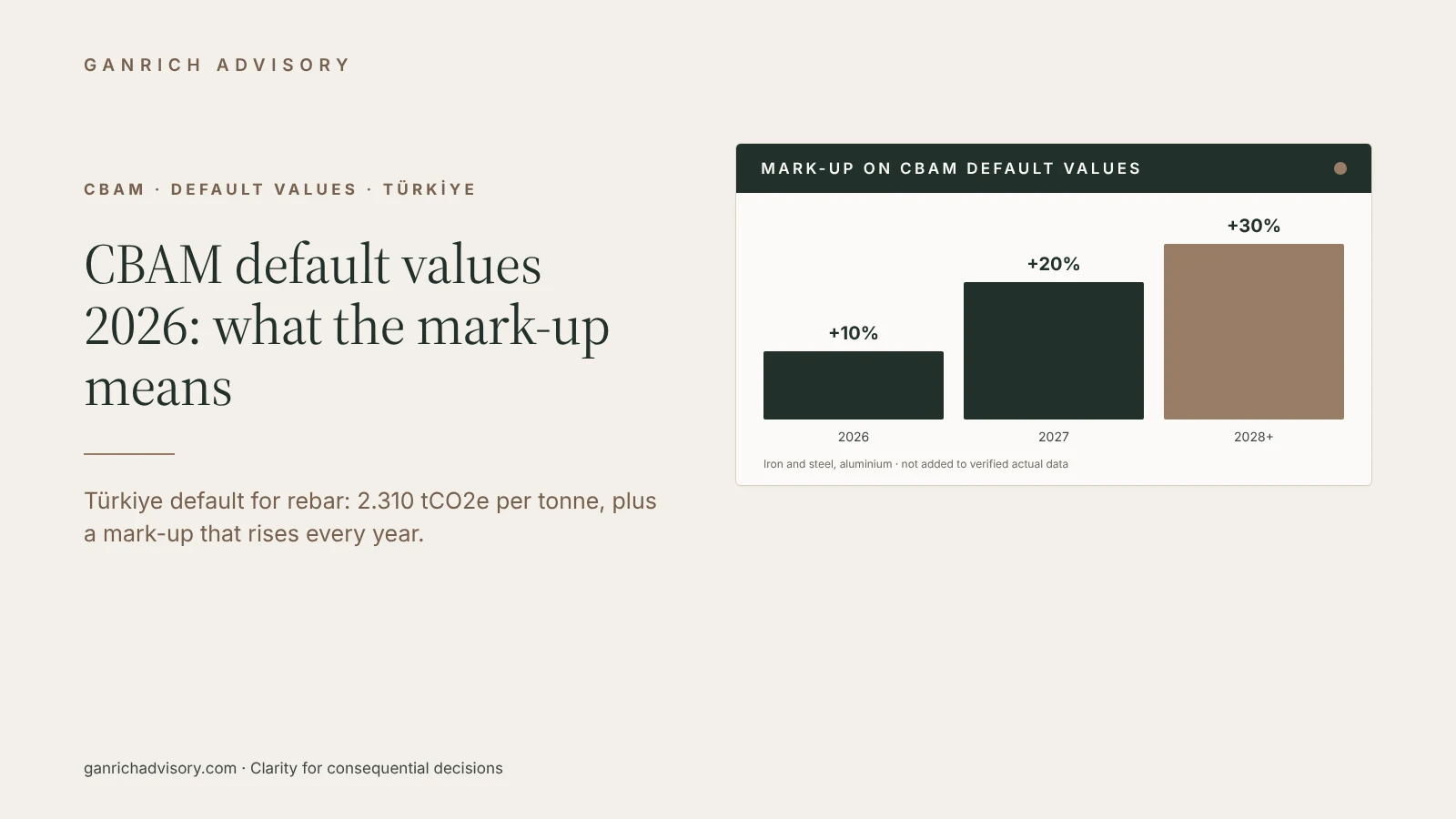
The mark-up: 10% in 2026, 30% from 2028
Default values must be increased by a mark-up that rises each year. It applies to default values, not to verified actual data.
| Sector | 2026 | 2027 | 2028 onwards |
|---|---|---|---|
| Iron and steel, aluminium, cement, hydrogen | 10% | 20% | 30% |
| Fertilisers | 1% | 1% | 1% |
Source: Commission CBAM Q&A (last updated 15 October 2026), 4.25. The Commission adds that the defaults including the mark-up are set so that embedded emissions are not underestimated, so it should "in most cases" be more advantageous to use actual values where they are available.
Türkiye default values for three common products
| CN code | Product | Default value, total (tCO2e per tonne) |
|---|---|---|
| 7214 20 00 | Rebar: bars and rods with indentations, ribs or other deformations | 2.310 |
| 7208 | Hot-rolled flat products of iron or non-alloy steel, width ≥ 600 mm | 2.428 |
| 7601 | Unwrought aluminium | 1.700 |
Source: Commission Excel "Default values definitive period", Türkiye sheet, version 2 (6 August 2026), based on Regulation (EU) 2026/1740. For these three goods the Türkiye table lists direct emissions only; indirect emissions show "N/A". Check your own CN codes in the regulation before relying on any figure.
Worked example: 1,000 tonnes of rebar
Using the Türkiye default for CN 7214 20 00 (2.310 tCO2e per tonne) and the mark-up for each year:
- 2026: 2.310 × 1.10 = 2.541 tCO2e per tonne, or 2,541 tCO2e for 1,000 tonnes.
- 2027: 2.310 × 1.20 = 2.772 tCO2e per tonne, or 2,772 tCO2e.
- 2028 onwards: 2.310 × 1.30 = 3.003 tCO2e per tonne, or 3,003 tCO2e.
These are embedded emissions, not the number of certificates. The certificates an importer surrenders are reduced by the adjustment for EU free allocation and by any carbon price effectively paid in the country of production. If your verified intensity for the same product is below the marked-up default, actual data lowers your buyer's CBAM cost; if it is above, the default is the cheaper figure for now, but the gap narrows as the mark-up rises.
What using actual emissions requires
- Verification: actual emissions declared for goods imported from 1 January 2026 must be verified by an accredited CBAM verifier. The declarant includes the operator's calculation and the verification report in the CBAM declaration (Q&A 5.9).
- A first physical site visit: the verifier must visit the installation the first time; a virtual visit or waiver is possible only in later years under strict conditions (Q&A 5.15).
- The right year: for goods imported in 2026, the reporting period is 2026. If there are no actual verified emissions for 2026, default values must be used (Q&A 5.17).
- No LCA shortcuts: emission factors from life-cycle assessments or life-cycle inventory databases are not accepted (Q&A 4.24).
- Timing: national accreditation bodies were expected to issue the first CBAM accreditations around September 2026, with verification work in early 2027 (Q&A 5.12).
When actual data pays off, and when it does not
Compare your own intensity with the marked-up default, product by product. Actual data pays off when your figure is clearly lower and the volume to the EU is large enough to carry the cost of monitoring and verification. It may not pay off for small or one-off flows, or where your route is more emissions-intensive than the default. Agree with each EU buyer who pays for verification and how the CBAM cost is reflected in price. Our report Actual or default? The CBAM data decision for Turkish metal exporters sets out that decision.
Key dates
Sales of CBAM certificates start on 1 February 2027. The first annual CBAM declaration, for goods imported in 2026, is due by 30 September 2027 (Q&A).
FAQ
What is a CBAM default value?
The embedded-emissions value per tonne, set by the Commission by country and CN code, that the EU declarant uses when verified actual data is not available. The 2026 values are in Annex I to Implementing Regulation (EU) 2025/2621, as corrected by Implementing Regulation (EU) 2026/1740.
How large is the mark-up?
10% in 2026, 20% in 2027 and 30% from 2028 for iron and steel, aluminium, cement and hydrogen; 1% for fertilisers from 2026 (Commission CBAM Q&A, 4.25).
Do actual emissions have to be verified?
Yes. Actual emissions declared for goods imported from 1 January 2026 must be verified by an accredited CBAM verifier, and the verification report goes with the declaration (Q&A 5.9).
What if Türkiye has no value for my product?
If the product is not listed for Türkiye or the field shows "-", the declarant uses the "Other countries and territories" table, which averages the ten exporting countries with the highest emission intensities (Q&A 4.25–4.26).
Can we use our LCA or EPD figures instead?
No. Emission factors from life-cycle assessments or life-cycle inventory databases are not accepted for calculating embedded emissions of CBAM goods (Q&A 4.24).
To see where your data stands, take the CBAM readiness check. For prices and the TR ETS link, see CBAM 2026: prices and TR ETS. Our CBAM data readiness work prepares the file your buyer needs.
Sources
- European Commission, CBAM legislation and guidance (accessed 9 Nov 2026): taxation-customs.ec.europa.eu/carbon-border-adjustment-mechanism/cbam-legislation-and-guidance_en
- European Commission, Default values definitive period (Excel, version 2, 6 Aug 2026, Türkiye sheet; information only): taxation-customs.ec.europa.eu/document/download/1c05d211-80cb-4aaa-8ef0-e08005a95d7e_en?filename=DV%20correcting%20act_final%20update_06.08.xlsx
- European Commission, CBAM Questions and Answers, last updated 15 Oct 2026, sections 4.24–4.26, 5.9, 5.12, 5.15, 5.17: taxation-customs.ec.europa.eu/document/download/013fa763-5dce-4726-a204-69fec04d5ce2_en
Keep this guide
Get the link and the related PDF in your inbox, to read later or forward to a colleague.
Dates and sources last checked 9 November 2026. General information, not legal advice.