Turkish boards discussing the Gulf usually start with one question: Dubai or Riyadh? It is the wrong first question; the country is the third or fourth decision. This piece sets out the sequence, the rules behind each step, and the tests to run before committing capital.
Ask "which customer, which proof" before "which country"
- Who is the first buyer? A distributor, a retailer, an industrial user or a government entity; each points to a different entry model.
- What must the first 90 days prove? Demand at your price, a partner who can execute, a clear compliance route.
- What is the smallest commitment that can prove it? A distributor shipment proves more about demand than a company licence.
Then compare countries.
Five entry routes, lightest to heaviest
- Direct export to an importer of record. Low cost, little control. The Saudi importer needs a commercial registration with the right activity code, plus any sector licence the activity needs (T.C. Ticaret Bakanlığı, Suudi Arabistan Pazar Bilgileri, 2026).
- Distributor or agent. Türkiye's Ministry of Trade advises Saudi distributors who can deliver, support and solve problems locally, exclusive nationwide or by region (Jeddah-West, Riyadh-Central, Dammam-East) (Ticaret Bakanlığı, 2026).
- Free-zone company in the UAE. Free zones have no foreign ownership restrictions (JAFZA website; DMCC website).
- Onshore company or branch. In the UAE, foreign investors can fully own companies in all legal forms, except activities with a strategic impact (UAE Ministry of Economy and Tourism). That list is set by Cabinet Resolution No. 55 of 2021: defence and security, banking, exchange houses, finance companies and insurance, telecoms, money printing, Hajj and Umrah services, Quran centres and fisheries.
- Partner or joint venture, by choice or because the activity requires it.
UAE as a test base, Saudi Arabia as a scale market
The UAE is usually the faster place to set up and test. DMCC says its setup process "takes around 10 working days" (DMCC website), a claim covering licensing only; bank accounts and visas take longer. Corporate tax is 0% up to AED 375,000 of taxable income and 9% above (Cabinet Decision No. 116 of 2022, Arts. 2–3), for financial years starting on or after 1 June 2023. Multinational groups with global revenue of €750 million or more in at least two of the four preceding years also pay a domestic minimum top-up tax that lifts their UAE effective rate to 15%, for financial years starting on or after 1 January 2025 (Cabinet Decision No. 142 of 2024; UAE Ministry of Finance).
A Qualifying Free Zone Person pays 0% on qualifying income, but sales to mainland customers qualify only for specific activities. For goods, that generally means distribution from a VAT Designated Zone (such as JAFZA) to a customer who resells or processes them (Ministerial Decision No. 229 of 2025). DMCC is a free zone but does not appear on the Designated Zone list (Cabinet Decision No. 59 of 2017, as amended). If non-qualifying revenue exceeds the lower of 5% of revenue or AED 5 million, the 0% regime is lost for that year and the next four (FTA, Free Zone Persons guide). VAT at 5% still applies to most mainland sales.
Saudi Arabia is usually the larger market and the harder base. Three rules shape the decision:
- Registration, not licensing. The Investment Law, published on 16 August 2024, entered into force 180 days later, in February 2025, together with its Implementing Regulations (Ministerial Decision No. 1086/1446), and repealed the old Foreign Investment Law (Art. 16; Bureau of Experts). Foreign investors now register with the Ministry of Investment (MISA) before investing (Art. 7). Some activities are prohibited or restricted for foreign investors (Art. 8).
- Wholly foreign trading is capital-heavy. MISA lists a minimum capital of SAR 30,000,000 for a 100% foreign commercial activity, with presence in at least three regional or global markets. It also requires an investment of at least SAR 300 million over five years (including the SAR 30 million capital), or SAR 200 million plus local manufacturing, R&D or logistics conditions. With a Saudi partner holding at least 25%, the minimum capital is SAR 26,666,667 (MISA, Investor Guide, 13th ed., February 2026). MISA has signalled some flexibility on these amounts for applicants with a detailed five-year business plan (Deloitte, May 2026), so treat them as the starting position, not the final number. Türkiye's Ministry of Trade cites the same SAR 30 million threshold as a reason for its distributor advice (Ticaret Bakanlığı, 2026).
- Tax. A Saudi company's profits attributable to non-Saudi, non-GCC shareholders are taxed at 20% income tax; the share held by Saudi and GCC shareholders pays zakat at 2.5% of the zakat base. VAT is 15% (ZATCA). With mixed ownership, both apply.
Regional headquarters (RHQ). Since 1 January 2024, Saudi government entities may contract with foreign companies that keep their Middle East and North Africa regional headquarters outside the Kingdom, and that appear on a list kept by MISA, only on restricted terms. The restriction also covers those companies' agents, distributors and suppliers for their goods and services (Council of Ministers Decision No. 461 of 1445H, Arts. 1, 3 and 5). Contracts worth an estimated SAR 1 million or less, and work performed outside Saudi Arabia, are exempt (Art. 4). In public tenders, a listed company's bid can be accepted only if it is the only technically acceptable bid, or the best technical bid and at least 25% cheaper than the next best (Art. 6). Government entities can also ask an exemption committee to approve a specific project or period (Arts. 9–10).
An RHQ needs a separate legal entity in Saudi Arabia (a company or registered branch), group presence in at least two countries other than Saudi Arabia and the group's head-office country, at least 15 full-time staff within a year, and no revenue-generating activity beyond RHQ functions (MISA, Terms and Conditions; Investor Guide, 13th ed.). In return, it gets 0% income tax on eligible income from eligible activities and 0% withholding tax on specified payments to non-residents, for 30 years, renewable (ZATCA, RHQ guideline, 2nd version, May 2026). An RHQ is rarely the entry move for Turkish companies. The trap: if you set up a MENA regional headquarters in Dubai and are listed, your Saudi distributor's sales of your products to government buyers can be caught as well.
"Is UAE-as-test-base costing me in both markets?"
A sceptical CEO's objection: a Dubai base could restrict me and my Saudi distributor on government contracts over SAR 1 million, and a DMCC company may miss 0% on mainland sales. Honest answer: it can, under conditions you can test in advance.
It costs you in Saudi Arabia when your target buyers are Saudi government entities on contracts above SAR 1 million, your UAE entity functions as your MENA regional headquarters, and your company is on MISA's list. The rule binds government entities (ministries, public bodies and government-founded non-profits), not private buyers. If you sell to state-owned companies or giga-project developers, ask whether they apply similar supplier rules.
It costs you in the UAE when more than 5% of your free-zone company's revenue, or more than AED 5 million, comes from non-qualifying sources, such as goods sold to mainland customers from a zone or activity that does not qualify. Cross that line and the company loses the 0% regime for that year and the next four, and is taxed under the standard rules (9% above AED 375,000). Most mainland sales also carry 5% VAT either way.
How to structure around it:
- If Saudi government buyers are core, test the RHQ rule before you name a UAE entity your regional headquarters. Whether a UAE sales office counts as one is a question for legal advice; MISA's list is updated quarterly and circulated to government entities (Art. 5), so ask your Saudi buyer or counsel whether you are on it. The alternatives are a Saudi RHQ, bidding on the narrow terms above (sole acceptable bid, or best technical bid at least 25% cheaper), or asking the government buyer to seek an exemption (Arts. 9–10).
- For UAE mainland goods sales, compare a Designated Zone distribution model, an onshore company, or a UAE distributor.
- If neither market's rules fit, skip the UAE base and go straight to a Saudi distributor.
Local partner: strategic choice, not legal must
In the UAE, a local shareholder is generally a choice. In Saudi Arabia, a partner is often the practical route: not always legally required, but the 100% foreign thresholds are high and buyers expect a local counterpart. Choose one for access, execution (warehousing, after-sales, spare parts) and regulatory work; Saudi buyers read physical presence as a sign someone will answer when problems arise (Ticaret Bakanlığı, 2026).
Protect yourself early: register your Saudi trademark in your Turkish company's name through a licensed Saudi IP agent with a legalised power of attorney, and hold pre-market approvals (food, medicines, medical devices) in your own name so a distributor change does not strand them (Ticaret Bakanlığı, 2026).
Relationship-led and public-sector buying
Saudi buyers prefer people they have met or were introduced to by someone they trust, so trade fairs beat email outreach (Ticaret Bakanlığı, 2026).
Tenders are announced on Etimad. Local content weighs most with Aramco and in defence. Aramco's iktva programme reached 70% local content across its procurement in early 2026 and now aims for 75% by 2030 (Aramco, February 2026); in defence, the national target is to localise more than 50% of military spending by 2030, against 27.3% at end-2025 (GAMI). These are programme-level figures, not a fixed rule for every tender, so check the local-content terms of each tender.
Product compliance and paperwork, early
- SABER (SASO's platform) registration, required for regulated products, is the importer's or local seller's obligation (Ticaret Bakanlığı, 2026; saber.sa).
- SFDA covers food, medicines, cosmetics and medical devices. Halal certificates must come from bodies the SFDA recognises; certificates issued under SMIIC standards are not accepted (Ticaret Bakanlığı, 2026).
- Legalisation. MISA registration needs your commercial register and last-year financials certified by the Saudi embassy (MISA, Investor Guide, 13th ed.).
- Arabic labelling: check the SASO or SFDA technical regulation for your product; labelling rules differ by product.
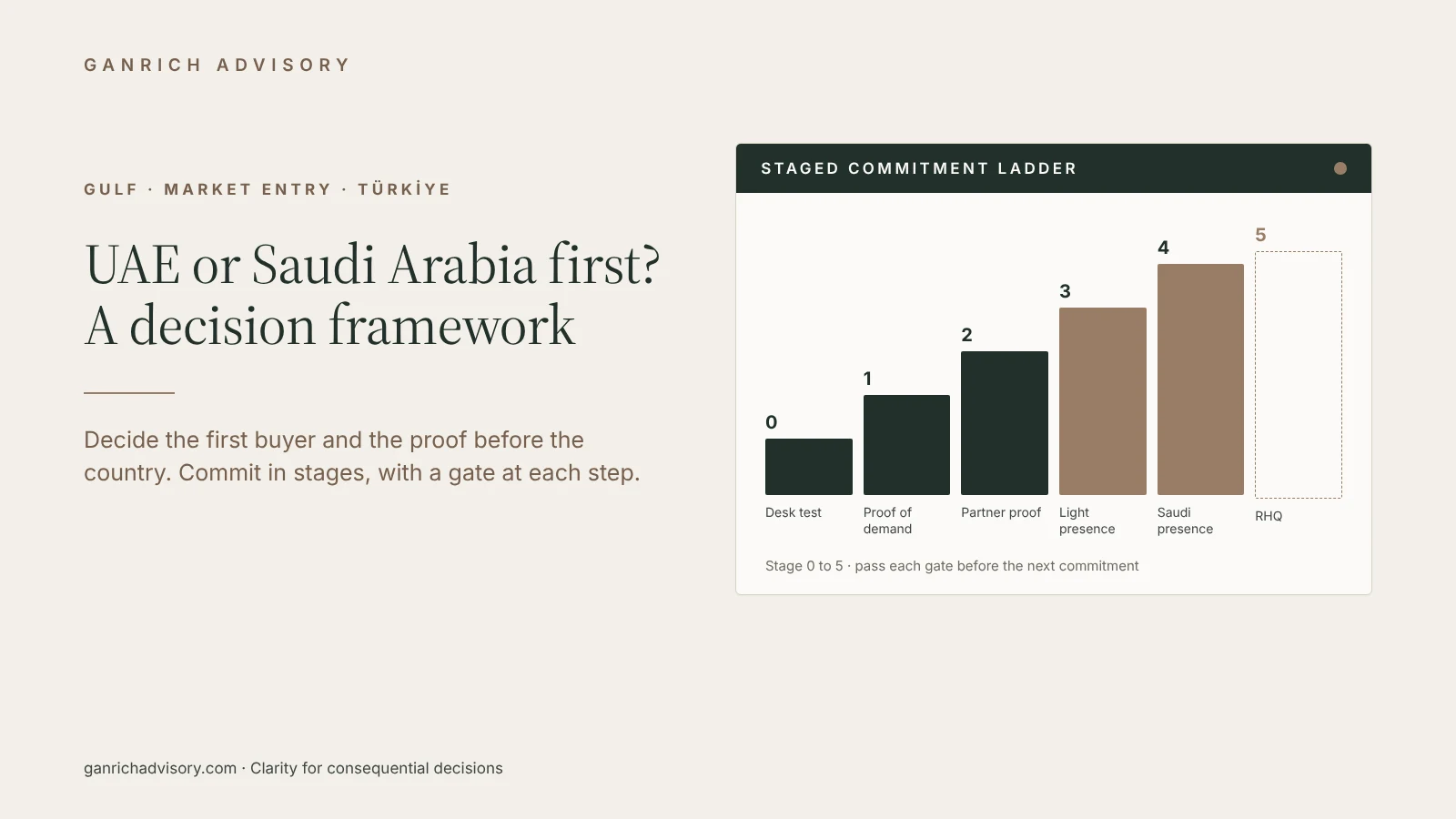
A staged-commitment ladder with go/no-go gates
| Stage | Commitment | Gate to pass before the next stage |
|---|---|---|
| 0. Desk test | Product compliance map; target buyer list | Product can be registered; no excluded activity |
| 1. Proof of demand | Fair visit; samples; first orders through a distributor | Repeat orders at target margin |
| 2. Partner proof | Distribution agreement with KPIs; trademark and approvals in your name | Partner hits KPIs for two to three quarters |
| 3. Light presence | UAE free-zone or onshore entity for regional sales and service | Regional revenue justifies fixed cost; RHQ and free-zone tests passed |
| 4. Saudi presence | MISA registration; Saudi entity, alone or with a partner | Saudi revenue, local content or public buyers require it |
| 5. RHQ | Only if government contracts are core | Government contracts above SAR 1m are core, and the business case covers RHQ substance (15 staff, 3 senior executives) |
This is the logic of market entry as a sequence of commitments and of our market entry work. On two-way capital flows, see The Türkiye–Gulf capital corridor.
FAQ
Do I need a local company to sell?
No. An importer or distributor can sell for you. You need a company to import, hold stock, invoice locally, or bid where local presence is required.
What does the UAE's 9% corporate tax mean for a free-zone company?
A Qualifying Free Zone Person pays 0% on qualifying income and 9% on other taxable income, without the AED 375,000 0% band. If non-qualifying revenue exceeds 5% of total revenue or AED 5 million (whichever is lower), the 0% regime is lost for five tax periods. Mainland sales are where most companies trip this rule; model them with a tax adviser before choosing a zone. General information, not tax advice; rules change and depend on your facts.
Next step
Test your case with our Market Entry Compass; see also the Decision Lab and Solutions.
Facts as of 9 November 2026. Rules differ by activity and emirate; this article is not legal or tax advice.
Keep this guide
Get the link in your inbox, to read later or forward to a colleague.
Dates and sources last checked 9 November 2026. General information, not legal advice.